
The AI IoT platform that turns every device into a decision.
StarSense is an AI IoT platform from Star Bit Solutions that connects sensors, machines and building systems, monitors them in real time and acts on what it sees. Predict failures before they stop production, cut energy waste and close the safety gaps that fragmented device ecosystems leave open.
Devices that cannot talk to each other cannot protect you
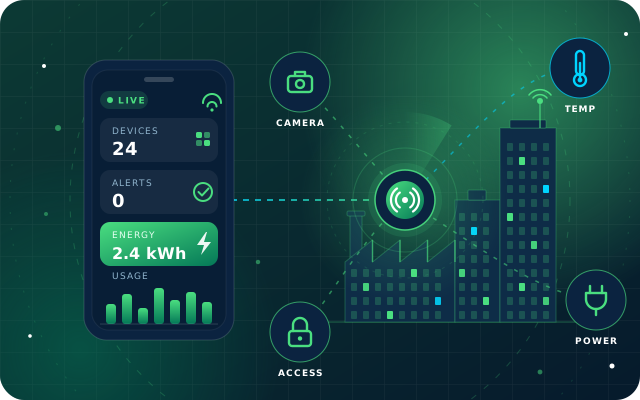
Most sites already have plenty of sensors, meters and controllers. What they lack is one layer that understands them together. StarSense gives every device a place in a single, secure picture, so problems are seen early and handled automatically.
Fragmented device ecosystems
Building management, machines, meters and cameras each arrive with their own app, protocol and login. Nobody sees the whole site, and integration projects stall. StarSense speaks the common protocols and brings every device into one registry and one dashboard.
Reactive maintenance
A machine fails, production stops, and a technician is sent to find out why. Predictive maintenance reads vibration, temperature, current and run-hours to flag wear before it becomes downtime, so repairs are planned rather than forced.
Energy waste
Chillers cooling empty floors, compressors leaking overnight, lighting left on across the weekend. Energy monitoring per zone and asset shows where consumption drifts from its baseline and automates the response.
Blind spots in safety and compliance
Temperature excursions in cold rooms, gas levels in plant rooms, doors left open, water leaks nobody notices until Monday. Continuous monitoring with a time-stamped log gives you the evidence, not just the alarm.
One AI IoT platform, six jobs done properly
StarSense is organised around the questions operations teams actually ask: what is happening now, what is about to fail, where is the energy going, what should happen automatically, who needs to know, and is all of it secure.
Real-time device and sensor monitoring
Every connected device streams into a time-series store and appears on live dashboards within seconds, with history you can query for any period.
- Device registry with location, type, firmware and owner per asset
- Live telemetry for temperature, humidity, vibration, current, flow, pressure and occupancy
- Time-series storage with retention rules and downsampling for long histories
- Dashboards per site, floor, line or asset with drill-down to raw readings
- Device health: heartbeat, signal strength, battery level and last-seen status
- Floor-plan and process views that place readings where the equipment sits
- Threshold, rate-of-change and missing-data conditions on any metric
- Scheduled reports and exports in PDF and XLSX
What operations teams notice first
The first week of live data usually shows a pattern nobody expected: a machine idling on full power, a cold room cycling too often, a floor occupied after hours. Visibility alone starts the savings.
Explore StarSense by industryPredictive maintenance and anomaly detection
Models learn the normal behaviour of each asset from its own history, then flag deviations early enough to schedule a repair instead of surviving a breakdown.
- Per-asset baselines learned from vibration, temperature, current and cycle data
- Anomaly scores that rise before a hard threshold is crossed
- Wear indicators for motors, pumps, compressors and HVAC units
- Maintenance work orders raised automatically in StarBiz or your CMMS
- Run-hour and cycle counters for usage-based servicing
- Root-cause views that correlate events across neighbouring sensors
- Feedback loop: technicians confirm or dismiss alerts to retrain the model
- Maintenance history and cost per asset for repair-or-replace decisions
What maintenance managers notice first
Alerts that arrive before a failure, with the readings that triggered them, so a technician walks in with the right part. Planned interventions replace emergency call-outs.
Connect work orders to StarBiz maintenanceEnergy optimisation and performance analytics
Meter every zone and major asset, compare it with a baseline and let StarSense recommend or apply the changes that reduce consumption without affecting comfort or output.
- Sub-metering per floor, tenant, production line or asset
- Baseline models that account for occupancy, weather and production volume
- Consumption, demand and power-quality dashboards with cost allocation
- Anomaly alerts when a zone drifts from its expected profile
- Schedule and setpoint optimisation for HVAC, lighting and compressed air
- Overall equipment effectiveness (OEE) and utilisation for machines
- Peak-demand warnings and load-shifting suggestions
- Reports for management, tenants and sustainability disclosures
What facility managers notice first
A ranked list of where energy is being lost and what it costs, refreshed daily. The savings conversation moves from guesswork to a plan with owners and dates.
Request an energy monitoring pilotRules-based and AI-powered automation
Turn readings into action. Simple rules handle the obvious cases; AI handles the ones that depend on patterns, forecasts and several signals at once.
- Visual rules engine: conditions across any device, time window and state
- Remote control of relays, valves, setpoints and actuators from dashboard or mobile
- Scheduled routines for lighting, HVAC, pumps and access
- AI-driven actions such as pre-cooling ahead of demand or throttling idle equipment
- Safety interlocks and manual override with a record of who changed what
- Escalation chains when an action does not clear the condition
- Scenario modes: occupied, unoccupied, maintenance, emergency
- Dry-run mode to test rules against live data before they take control
What plant managers notice first
Routine adjustments stop depending on someone remembering. The dashboard shows each automated action and its result, and a person can pause any rule at any time.
Talk through your automation use caseIntelligent alerts and integrations
The right person hears about the right event through the channel they actually read, and the data flows into the business systems that need it.
- Alerts by email, in-app notification and WhatsApp through StarBot
- Severity levels, quiet hours, deduplication and acknowledgement tracking
- Escalation to a second contact when an alert is not acknowledged
- Two-way WhatsApp: ask StarBot for a reading or a status and get a live answer
- Work orders and production data exchanged with StarBiz maintenance and manufacturing
- REST API and webhooks for ERP, CMMS, BMS and custom applications
- Scheduled exports to data warehouses and reporting tools
- Ticketing hand-offs for facilities and IT teams
What on-call staff notice first
Fewer, better alerts. Duplicates are merged, the message says what happened and what to check, and a reply on WhatsApp acknowledges it.
See how StarBot handles conversationsSecurity across devices, data and users
IoT security fails at the edges, so StarSense treats every device as an identity, every connection as untrusted until proven otherwise and every action as something to log.
- Unique identity and credentials per device, with individual revocation
- TLS encryption from gateway to platform and between services
- Role-based access by site, zone, asset and action
- Audit logs for configuration changes, commands and acknowledgements
- Network segmentation guidance for OT and IT environments
- Gateway and firmware update management
- On-premise, private cloud or managed cloud deployment
- Backups, retention policies and data-residency options
What IT and OT teams notice first
A single place to see which devices exist, who can control them and what has changed. Security stops being a spreadsheet of default passwords.
Deployment and security detailsFrom sensor to action in four layers
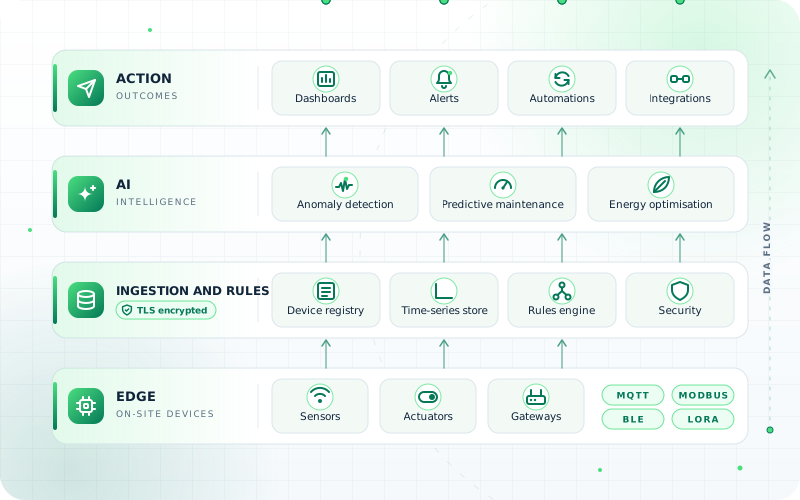
StarSense is built as a pipeline. Each layer has one job, uses open protocols where they exist, and can run at the edge, on your own servers or in the cloud.
Edge
Sensors, actuators and gateways on site. StarSense gateways speak MQTT, Modbus, BLE and LoRaWAN, so existing meters, PLCs, beacons and long-range sensors connect without replacement. Local buffering keeps readings safe when the link drops.
Ingestion and rules
A device registry authenticates every source, a time-series store keeps the history, and the rules engine evaluates thresholds and schedules as data arrives. Identity, TLS and role-based access live at this layer.
AI
Anomaly detection, predictive maintenance and energy optimisation models run on the stored telemetry, learning each asset's normal behaviour and scoring deviations. Outputs are alerts, recommendations and, where you allow it, actions.
Action
Dashboards for people, alerts through email and WhatsApp via StarBot, automations that command devices, and integrations that raise work orders in StarBiz maintenance or feed production data to planning.
- Edge protocols
- MQTT, Modbus, BLE, LoRaWAN
- Data store
- Time-series with retention and downsampling
- Rules engine
- Threshold, schedule, multi-condition, AI-triggered
- Deployment
- On-premise, private cloud or managed cloud
- Interfaces
- Web dashboards, mobile, REST API, webhooks, StarBiz and StarBot connectors
Intelligence that learns your site
Fixed thresholds create noise. StarSense models learn what normal looks like for each asset, zone and season, then tell you when something is genuinely different and what to do about it, with a person always able to accept, adjust or ignore the suggestion.
Anomaly detection
Multivariate models score each reading against the asset's own history and its neighbours, catching slow drifts and sudden shifts that a fixed limit would miss or flag too late.
Predictive maintenance
Wear signatures in vibration, temperature and current are matched against known failure patterns to estimate when an asset needs attention, and a work order is prepared before it stops.
Energy optimisation
Baseline models separate weather, occupancy and production effects from genuine waste, then recommend schedules and setpoints that cut consumption without affecting comfort or output.
Automation you can trust
AI-triggered actions pass through the same rules engine as manual ones, with limits, dry-run mode and an audit trail, so you decide how much autonomy each system gets.
Ask your devices
Through StarBot, a manager can ask on WhatsApp "what is the temperature in cold room 2" or "which pumps alerted this week" and receive an answer from live data.
Human in the loop
Every alert can be confirmed or dismissed by a technician, and that feedback retrains the model. The platform gets better at your site the longer it runs.
Built for the places where things need watching
The same platform, configured very differently for a villa, a tower, a factory floor or a fleet of refrigerated trucks. Here is what it watches in each.
Smart homes and villas
Lighting, climate, water leaks, gate and door status, energy per circuit and routines that follow the household, controlled from one app and secured per user.
- Climate
- Leak detection
- Access
- Energy
Offices and commercial buildings
Occupancy-based HVAC and lighting, indoor air quality, tenant sub-metering, lift and pump health, and one view for facility managers across floors and sites.
- BMS
- Air quality
- Sub-metering
- Occupancy
Factories and plants
Machine telemetry, OEE, predictive maintenance for motors and compressors, compressed-air and energy monitoring, with work orders flowing to StarBiz production and maintenance.
- OEE
- Vibration
- Compressed air
- Work orders
Healthcare facilities
Continuous temperature logging for medicine fridges and blood banks, air-handling and pressure monitoring for clean areas, and an audit trail ready for inspections.
- Fridge monitoring
- Clean rooms
- Audit trail
- Alerts
Utilities and smart-city infrastructure
Water and power meters, pump stations, street lighting and environmental sensors over LoRaWAN, with district-level dashboards and automated fault dispatch.
- LoRaWAN
- Metering
- Pump stations
- Street lighting
Cold chain and logistics
Temperature and door sensors in trucks, containers and warehouses, location-linked excursion alerts and shipment reports that prove compliance to customers.
- Reefer monitoring
- Excursions
- Warehouses
- Compliance reports
Secure at the device, your choice of where it runs
An IoT platform is only as safe as its weakest sensor. StarSense applies the same discipline from the edge to the dashboard, whether it runs in your plant room, your data centre or a managed cloud.
Device identity
Each device and gateway receives its own credentials at enrolment. Lost or compromised devices are revoked individually, without touching the rest of the fleet.
Encrypted transport
TLS on every connection from gateway to platform and between services. Local buffering on the gateway holds readings through a dropped link and uploads them when it returns.
Role-based access
Permissions by site, zone, asset and action. A tenant sees their floor, a technician can acknowledge but not reconfigure, an administrator can do both, and every step is logged.
Audit logs
Configuration changes, commands sent to devices, alert acknowledgements and rule edits are recorded with user, time and previous value, ready for inspections and incident reviews.
On-premise or cloud
Run the full stack on your own servers for data residency, in a private cloud, or as a managed service by Star Bit Solutions. The security model is identical in each case.
Have a security questionnaire or an OT network policy we need to fit into? Send it to info@starbitsolutions.com or message us on WhatsApp and an engineer will answer point by point.
From site survey to a site that optimises itself
IoT projects fail when they start with hardware instead of questions. Our method starts with what you need to know and works back to the sensors.
Site survey
We walk the site with you, list the assets and risks that matter, check connectivity and existing systems, and agree the first measurable outcomes.
Pilot devices
A small set of sensors and a gateway go live on the highest-value assets. You see real data within days while we validate protocols, coverage and power.
Rules and dashboards
Thresholds, schedules, alert routing and dashboards are configured with your team, and the first automations run in dry-run mode before they take control.
Scale-out
Proven device types roll out across floors, lines or sites, with the registry, access roles and StarBiz integration extended to match.
Optimisation
AI models train on the growing history, energy and maintenance recommendations begin, and regular reviews turn the data into the next set of improvements.
One team from gateway to work order
Most IoT projects involve a hardware vendor, a platform vendor and an integrator who blame each other when the dashboard stays empty. With StarSense, the engineers who choose the gateway also write the rules and connect the ERP.
- StarSense, StarBiz and StarBot are built to work together, so there is no integration project between vendors
- Honest scoping: a pilot before a rollout, and a hardware list with pricing before commitment
- Based in Ras Al Khaimah, on site across the UAE and remote wherever your assets are
- Building business software since 2014, with AI at the core of every product
We do not lead with hardware. We start from the question a manager needs answered, then choose the smallest set of devices that answers it reliably.
See StarSense on your site, not a slide deck
Tell us what you need to watch: a cold room, a compressor, a floor of offices or a whole plant. We will propose a pilot with a sensor list, a gateway plan and the dashboards you would see.
- Pilot scoped around your highest-value assets
- Clear hardware list, timeline and pricing before any commitment
- Advice from the engineers who will install and configure it
Request a StarSense pilot
Tell us a little about your site and we will come back within one business day.
StarSense, answered
What kinds of devices and sensors can StarSense connect?
Temperature, humidity, vibration, current and power, flow, pressure, occupancy, air-quality and door sensors, energy meters, PLCs and building controllers, and actuators such as relays and valves. StarSense gateways speak MQTT, Modbus, BLE and LoRaWAN, so most industrial and building devices connect without replacement.
Do we need to replace our existing sensors, PLCs or building systems?
Usually not. StarSense reads from existing Modbus and MQTT devices, building management systems and meters through gateways, and adds new wireless sensors only where there is a gap. The site survey identifies what can be reused.
How does predictive maintenance work in StarSense?
The platform learns the normal vibration, temperature, current and cycle profile of each asset from its own history. When readings drift from that profile, an anomaly score rises and an alert or work order is raised before a hard failure. Technician feedback on each alert improves the model over time.
Can StarSense run on-premise, or does it require the cloud?
It does not require the cloud. The full stack can run on your own servers or private cloud for data residency, or as a managed cloud service. Gateways buffer readings locally and upload them when the link returns, so a typical internet outage does not lose data.
How are alerts delivered, and can they reach WhatsApp?
Alerts go out by email, in-app notification and WhatsApp through StarBot, with severity levels, quiet hours, escalation and acknowledgement tracking. Team members can also ask StarBot for a live reading or a device status on WhatsApp.
Does StarSense integrate with our ERP or maintenance system?
Yes. StarSense connects natively to StarBiz for maintenance work orders and production data, and to other ERP, CMMS and building management platforms through its REST API and webhooks.
How do we start a StarSense project?
Book a free site survey. We list the assets and risks that matter, propose a pilot with a hardware list, timeline and pricing, and put live data on a dashboard within days of the pilot devices being installed.
Ready to hear what your site is telling you?
Book a free site survey. We will map your assets and risks to StarSense and propose a pilot you can see working within days, with no obligation.