The Challenge
The client produces concerts, comedy nights and family shows at venues around the UAE. As in much of Media and Entertainment, interest peaks the moment a show is announced, and every announcement triggered a wave of the same questions on Instagram and Facebook messages, WhatsApp and the website contact form: what time doors open, whether children are allowed, which language the show is in, where to park, whether the venue is wheelchair accessible and where to find their tickets after buying.
A small marketing team and the box office answered from shared phones and personal accounts, between their other work. Replies took hours, and the evening peak after a campaign went out was often answered the next morning, by which time some buyers had moved on. Answers also varied from person to person, especially on refunds, ticket transfers and age limits, and high-value inquiries for group and corporate bookings were buried among the repeat questions.
Behind the scenes, the events team ran show days on personal calendars, notes apps and chat groups. Tasks such as confirming artist arrival times, approving social posts and checking the venue run sheet lived in different places for different people, and reminders were easy to miss.
- The same audience questions answered by hand on several channels
- Slow replies at the evening peak, when interest was highest
- Inconsistent answers on refunds, transfers and age limits
- Group and corporate booking inquiries lost among routine messages
- Show-day tasks and schedules scattered across personal apps
Our Approach
We started by reviewing a sample of real conversations from each channel with the marketing lead and the box office supervisor, and grouped every message by topic. Most fell into a short list of repeat questions, while a smaller group needed a person: refunds, accessibility arrangements, complaints and group bookings. That split became the design brief for StarBot: answer the repeat questions instantly, and route the rest to the right desk with the context attached. Handover rules were agreed before a single answer was written, one of the points covered in our guide to choosing a conversational AI chatbot.
The knowledge base was written in Arabic and English. Venue and policy answers that rarely change sit alongside a show sheet for each production, with dates, doors-open time, running time, age policy, language, parking, accessibility and the official ticket link. Marketing and venue operations approve every answer before it is published, and the show sheet is now part of the announcement checklist, so the assistant knows about a show before the audience does.
We piloted on the website for an upcoming show, reviewed transcripts with the team and closed the gaps, then connected the business WhatsApp number and the Instagram and Facebook inboxes, set up the WhatsApp message templates and opt-in flows, and tested every channel before launch. Alongside this, a discovery session for StarHub looked at how the events team actually plans a show day, and a pilot group used the planner before the rest of the team was invited.
The Solution
One Assistant on the Website, WhatsApp and Social Inboxes
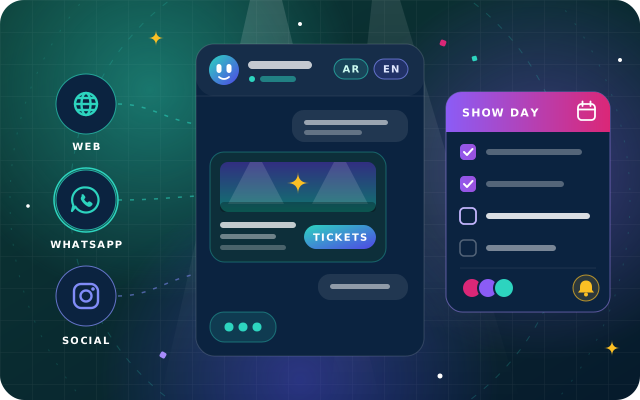
StarBot runs on the website through an embed snippet, on the client's business WhatsApp number and in the Instagram and Facebook message inboxes, all from one knowledge base. Each message is answered in the language it was written in, Arabic or English, and conversation history follows the audience member across channels. Rich replies keep conversations short: buttons to pick a show, quick replies for common topics, cards with the date, venue and ticket link, and a venue map sent as an image when someone asks how to find the entrance.
Show Sheets, Guardrails and Handover
Content guardrails stop the assistant promising anything beyond the published policy, and refunds, accessibility requests and complaints are always handed to a person. Human handover is routed by topic and business hours: ticketing problems go to the box office, group and corporate inquiries to the partnerships team, and anything after hours becomes a captured request with a promised call-back. The agent receives the full transcript and any order reference the bot has already collected, so nobody has to repeat their story. Group inquiries follow a guided flow that asks the questions the partnerships team needs and sends a hot-lead alert by email or WhatsApp, while ticket sales stay on the official ticketing page that every show card links to.
Learning from Every Announcement
After each campaign, the analytics dashboard shows which channels, languages and hours carried the most conversations, the top intents and the questions trending week on week, and how many were resolved without a person. Unanswered and low-confidence questions go to a review queue, and marketing uses the trending list to improve event pages: when parking questions rise for a new venue, the answer goes into the show sheet and onto the event page before the next campaign. A short satisfaction survey closes each conversation.
StarHub for the Team behind the Shows
The events team uses a team deployment of StarHub on phone, tablet and web. Each show has a shared plan in a team space, with tasks, due dates, priorities and sub-tasks for marketing, production and the box office, while every person keeps a private planner and notes alongside it. Recurring tasks cover the content calendar, the focus view shows only what is due today on a show day, and voice memos recorded after a venue walk-through are saved as notes attached to the task they relate to. Only the planner, notes and AI assistant modules were switched on for the team, and the assistant times each person's reminders around their own calendar.