The Challenge
The client produces television commercials, corporate films and branded social content for agencies and brands. A small core team of producers, editors and motion designers works with a wide pool of freelancers on every job, from directors of photography and sound recordists to gaffers, make-up artists and drivers, alongside studio hire, camera and lighting rental, locations, permits and catering.
Each producer kept a budget spreadsheet for their own productions, while finance kept the books in a separate accounting package. Freelancer days and overtime were agreed by phone and confirmed in chat threads, and invoices for crew, studios and equipment arrived long after the shoot had wrapped. Most of these costs were posted to general expense accounts, so nobody could see what a single production had really cost until well after delivery.
Billing had the same gap. Client contracts set out milestone payments for pre-production approval, shoot completion and final delivery, but finance only learned that a stage was complete when a producer remembered to mention it. Extra edit rounds and additional shoot days were often absorbed rather than billed, because by the time anyone noticed, the client had already signed off.
- Freelancer days and overtime recorded in personal notes and chat threads
- Studio, equipment and location costs coded to general expenses instead of a production
- Milestone invoices raised late, or missed altogether
- Margin per production known only after the books were closed
- No reliable view of which clients and types of work were profitable
Our Approach
We began with discovery workshops with the managing partner, the head of production, producers and the finance lead, then followed a live job from brief and estimate to final delivery and the last freelancer payment. Mapping it end to end showed where money is really committed in a production company: when a freelancer, a studio or a camera package is booked, not when the invoice arrives.
The fit-gap review against StarBiz projects, timesheets and billing confirmed that the standard modules covered milestones, timesheets with approval and billable rates, budgets, committed costs, profitability per project, and milestone and time-and-material invoicing, which is the starting point we use across Media and Entertainment. The design work therefore went into the details: budget categories that match the way producers already build an estimate, a vendor record with an agreed day rate for every regular freelancer, and a rule that every booking becomes a purchase order against its production.
We agreed a phased plan. The first phase moved new productions, purchasing and finance onto StarBiz, while jobs already in progress were finished in the old spreadsheets to avoid a messy part-migration. The second phase added milestone invoicing and the customer portal, and the third brought in the project dashboards and the AI anomaly checks.
Data preparation focused on the freelancer list, which held the same people under several spellings, and on a chart of accounts that treats production costs as cost of sales by category. Producers tested the setup on live productions alongside their spreadsheets, and training was role-based: producers and coordinators on bookings, timesheets and milestones, finance on matching and invoicing, and management on the dashboards.
The Solution
Every Production Is a Project with a Budget
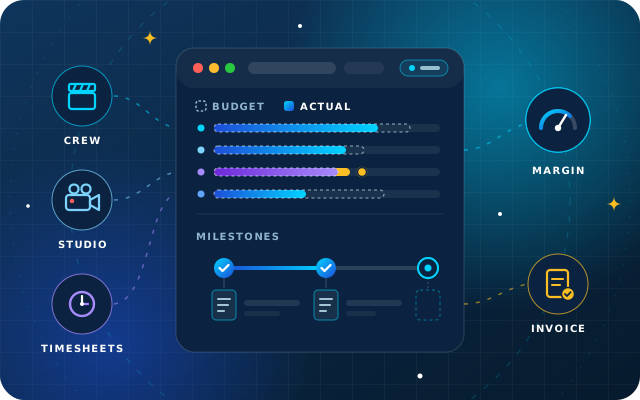
Each approved estimate is confirmed as a quotation and opened as a project in StarBiz, with budget lines for crew, equipment, studio and locations, talent, post-production, and travel and logistics. Tasks follow the production stages, from pre-production and shoot days to offline edit, color grade, sound mix and client revisions, and the resource planning view shows which editors and motion designers are booked across productions.
Freelancer Bookings and Timesheets
Booking a freelancer, a studio or a camera package means raising a purchase order against the production, so the cost shows as committed straight away. Editors and motion designers log their own hours on project tasks, and the production coordinator records crew days and overtime from the call sheet at the end of each shoot day. Crew days are recorded without a cost rate, because the purchase order already carries that cost, so the same day is not costed twice. The producer approves the timesheets, and each freelancer invoice is matched against its purchase order and the approved days before it can be paid. Shoot-day expenses such as fuel, parking and crew meals are submitted through employee self-service and charged to the same production.
Milestone and Time-and-Material Invoicing
Each project carries the milestones from the client contract and the share of the fee that each one releases. When a producer marks a milestone as reached, it becomes ready to invoice and finance sees it without waiting to be told. Invoices carry VAT from the configured rates. Extra edit rounds and additional shoot days are quoted as change requests and billed as new milestones or on time and material, and agency clients follow milestone status and invoices in the customer portal.
Profitability While the Job Is Running
The project dashboard compares budget, committed cost, actual cost and invoiced revenue for every production, and updates as timesheets, purchase orders and bills come in. The regular production review now runs from the same screen, so an overrun is discussed while there is still time to act. The StarBiz AI layer flags duplicate vendor bills, such as a freelancer invoice sent once by email and again by chat, and margin drops on a production before they reach the month-end report.