The Challenge
The client is a civil and building contractor with several sites active at any time and a central equipment yard. Its own plant includes generators, compressors, dewatering pumps, light towers, welding sets and compaction equipment, alongside hand tools and equipment hired in from rental companies whenever a site needs more.
Equipment moved between sites whenever another site needed it, by agreement over the phone and rarely on paper. The yard's list, the finance asset register and what was actually standing on each site all disagreed. Supervisors lost time searching for items that were assumed to be elsewhere, and the company sometimes hired in equipment it already owned because nobody could find its own. Servicing followed the calendar and guesswork, because nobody knew how long a generator or compressor had actually run since its last service.
Finance had its own problem. The fixed asset register was updated at year-end from the yard's list, so depreciation and insurance schedules rested on records nobody trusted, and scrapped or lost items were written off late. These are the challenges we see most often in Construction and Real Estate:
- Equipment nobody could locate: items assumed to be on one site turned up on another, or not at all.
- Hiring what was already owned: rental charges for equipment while owned items stood idle elsewhere.
- Calendar-based servicing: services missed on hard-working plant and done too early on idle plant.
- An asset register out of step: finance, the yard and the sites each kept a different list.
Our Approach
We started with a free site survey at the yard and at a representative selection of sites. With the plant manager, we listed the equipment that mattered most, checked connectivity and power on each site and agreed the questions the system had to answer: where each item is, whether it is working and when it needs a service. Physical verification came first, so every item had a tag number, an owner and a confirmed location before anything was connected.
The design matched the device to the item. Generators, compressors and pumps carry LoRaWAN current sensors connected to StarSense, and their current draw feeds run-hour counters. Smaller equipment carries BLE tags picked up by gateways at the yard and on each site, while hand tools stay as serial-numbered stock. The fit-gap against StarBiz confirmed that fixed assets, maintenance work orders and multi-location inventory covered the rest, using the native connection between StarSense and StarBiz maintenance rather than custom development.
The work was phased:
- Pilot: sensors and gateways on the highest-value plant at the yard and on a single site, with rules in dry-run mode while we checked coverage and readings.
- Register and maintenance: the verified asset register loaded into StarBiz, each device linked to its asset and service intervals set by run-hours for each equipment type.
- Scale-out: the proven device types rolled out across every site, with dashboards, alert routing and access roles for supervisors.
Supervisors, the yard team and the maintenance workshop were trained on the dashboards and alerts that concern them, and finance on asset transfers and disposals.
The Solution
Every Item in One Register, on Both Platforms
Each item of plant has a record in the StarBiz asset register with its tag, category, purchase cost, depreciation schedule and current site, and the matching device in the StarSense registry carries the same tag, type and owner. Moving equipment means recording a transfer to the new site, so finance, the yard and the sites read the same list. Hand tools are issued from yard stock to site locations by barcode. Plant that is scrapped or lost is disposed of against its asset record, while depreciation on the rest posts on schedule.
Where Each Item Is, and Whether It Is Working
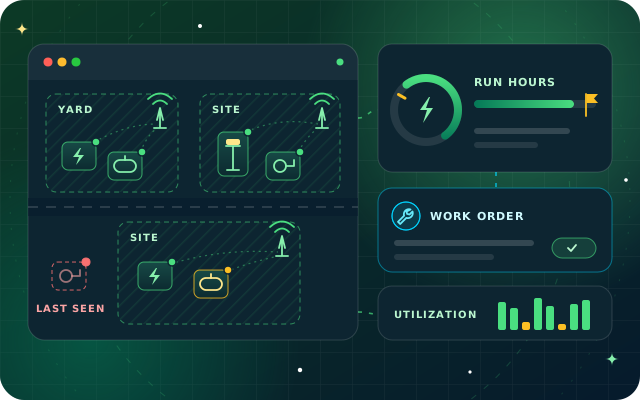
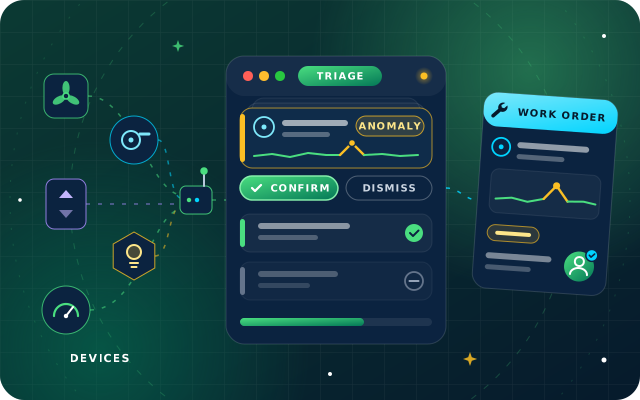
Gateways at the yard and on each site pick up the tags and sensors around them, and buffer readings locally when a site's connection drops. Dashboards for each site show the equipment reporting there, with heartbeat, battery level and last-seen status for every device and drill-down to the readings behind them. A missing-data rule alerts the site supervisor by email and in-app notification when a tagged item stops reporting, and escalates to the plant manager if nobody acknowledges it. Another rule flags plant that runs while the site is closed.
Servicing by Run-Hours, Not by Calendar
Run-hour counters in StarSense track how long each generator, compressor and pump has actually worked. When an item reaches its service interval, a maintenance work order is raised automatically in StarBiz for the workshop, so hard-working plant is serviced on time and idle plant is not serviced too early. Every completed job adds its cost to the asset's maintenance history, so repair-or-replace decisions start from its running cost and book value.
Utilization That Drives Hiring Decisions
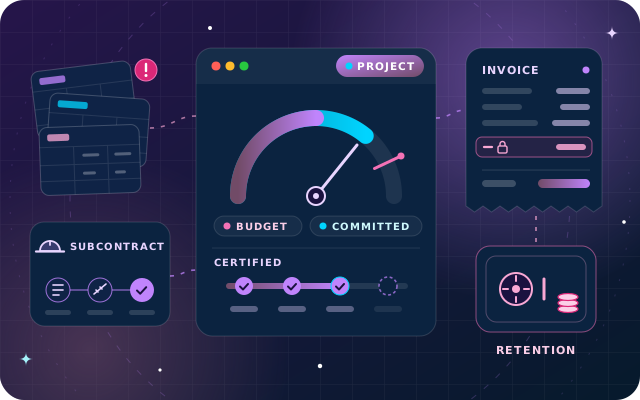
Utilization views show which items are working and which stand idle on each site. Before a site raises a request to hire equipment, the plant manager checks whether an owned item is idle elsewhere and moves it instead. Hired equipment is ordered through StarBiz purchasing against the project, so its cost reaches the project budget, and items that stand idle are off-hired rather than left on rent.