The Challenge
The client operates several restaurant concepts in the UAE, from casual family dining to evening venues that fill up at weekends. Reservations had grown organically: guests called or sent WhatsApp messages to whichever manager or host they knew, and bookings were written in a paper diary or a shared spreadsheet at each outlet.
That worked until it did not. Messages sent to someone on a day off went unanswered, tables were occasionally double-booked, and special requests for birthdays, high chairs or quiet corners were lost between shifts. Nobody reminded guests about their booking, so no-shows on busy evenings were only discovered when a table stood empty. Feedback arrived as public reviews after the event, and complaints sent to personal phones were sometimes never passed on.
There was also a data question. Guest names and numbers sat on staff members' own phones, with no control over who could see them or how long they were kept. These are challenges we see across Restaurants and Food Services:
- Reservations and complaints scattered across personal phones
- No booking confirmation and no reminder
- Special requests lost between shifts
- Feedback collected only through public reviews
- Guest data with no retention rules
Our Approach
Discovery brought together outlet managers, hosts and the operations team. We mapped the guest journey from first inquiry to booking, change or cancellation, arrival, the visit, feedback and, where needed, a complaint. For each step we agreed what a guest should be able to do alone and when a person must step in.
The group then wrote down the booking rules for each outlet: when bookings are accepted, how large a party can book in chat before the events team takes over, how long a table is held for late guests and how cancellations work. These rules, the menus, opening hours, parking guidance and the most common questions from real conversations became StarBot's approved knowledge base in Arabic and English. Our guide to choosing a conversational AI chatbot covers the same groundwork.
The fit-gap review found no need for custom software. StarBot already provides WhatsApp business messaging with templates and opt-in, guided booking flows with calendar checks, satisfaction surveys, rule-based escalation and analytics. The plan:
- Knowledge base, intents, booking flow and escalation rules defined and tested against sample conversations
- Business WhatsApp number connected, message templates approved and the opt-in flow agreed
- A pilot on the website widget and WhatsApp for a single concept, with transcripts reviewed together
- Rollout to every concept and to Instagram direct messages
Hosts and managers were trained on the shared team inbox, on taking over a conversation and on reading the list of bookings and special requests before each service. Personal numbers were then retired from guest communication.
The Solution
One WhatsApp Number for Every Booking
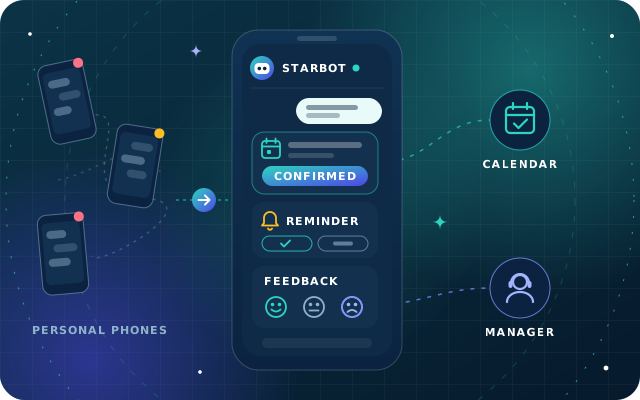
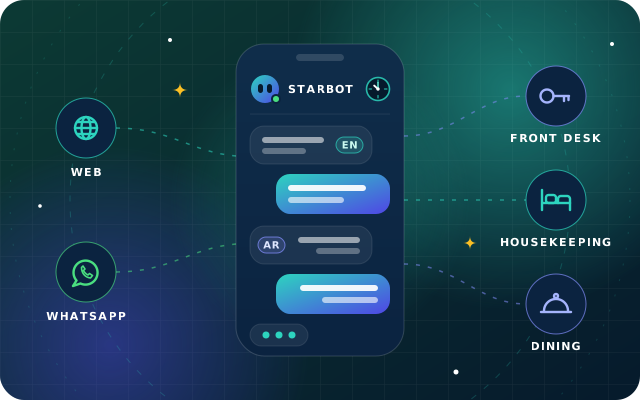
Guests write to the group's business WhatsApp number, the website chat widget or Instagram, and reach the same assistant. StarBot detects Arabic or English, asks for the outlet, date, time, party size, name and any special requests, and fills in missing details through the conversation. It checks the outlet's booking calendar before confirming, then sends a confirmation with buttons to change or cancel. Inquiries for large parties or private events are captured as leads, and the events team is notified at once by WhatsApp or email.
Reminders That Guests Can Answer
Guests opt in during the booking to receive messages about it. Before the visit, StarBot sends an approved WhatsApp template reminder with quick replies to confirm, change or cancel, and a cancellation updates the booking calendar so the table can be offered again. Each confirmed booking reaches the outlet with the guest's special requests, so hosts start every service with an accurate list.
Feedback after the Visit
After the visit, StarBot sends opted-in guests an approved template message inviting them to say how it went, and the short conversation that follows ends with a satisfaction survey. Scores appear in StarBot analytics, and negative sentiment in a guest's reply hands the conversation to the outlet manager, so an unhappy guest hears from the restaurant while the visit is still fresh.
Complaints Routed to the Right Manager
Escalation rules hand a conversation to a person when a guest uses complaint keywords, shows negative sentiment or simply asks for someone. Routing by topic, language and business hours sends it to the manager responsible for that outlet, in the shared team inbox, with the full transcript. Out of hours, StarBot records the details and promises a call-back, then resumes automatically once the manager closes the conversation.
Guest data now sits under retention controls the group sets per channel and purpose, and the analytics dashboard shows conversation volume by channel, language, hour and topic, the top questions and the unanswered ones queued for review.