Adaptive Learning for Corporate Training and Onboarding: Competence, Not Completion
Star Bit Solutions9 min read
Most corporate training measures who finished a course, not who can do the job. Adaptive learning for corporate training changes that with role-based paths, diagnostics that skip what people already know, spaced refreshers and dashboards that show competence.
Completion rates show who clicked through a course. Adaptive learning shows who can actually do the work, skill by skill.
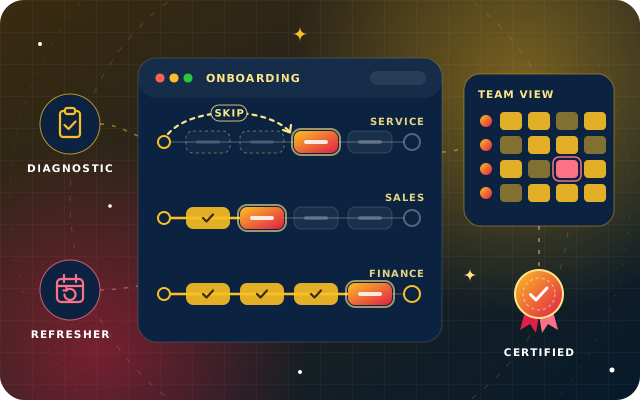
Short diagnostics let experienced hires skip what they already know, so onboarding time goes on the gaps that matter.
Memory research favors short compliance refreshers spaced through the year over one long annual course that is quickly forgotten.
Managers need a team view of mastery, at-risk flags and overdue refreshers, with access limited to the people they coach.
A new hire's first week often looks the same whatever they bring with them. Everyone sits through the same induction slides, the same product videos and the same compliance modules, then clicks through a quiz to earn a completion tick. The experienced hire is bored by Tuesday, the graduate is overwhelmed by Thursday, and a month later nobody can say with confidence who is ready to work alone.
Adaptive learning for corporate training starts from a different question: what can this person already do, and what do they need to learn next for their role? The answer changes how onboarding is built, how refreshers are scheduled and what managers look at. If the idea is new to you, start with our explainer on what adaptive learning is and how it works.
Why Completion Rates Mislead
Completion is easy to measure, which is why most training reports lead with it. But a completed course proves only that someone reached the last screen. It says nothing about whether they can calm a difficult customer, follow a safety procedure under pressure or post a supplier invoice correctly.
Training evaluators have long separated four levels of evidence, popularized by the Kirkpatrick model: how people reacted to the training, what they learned, whether their behavior at work changed and what results followed. A completion record sits below all four. Adaptive learning does not solve the whole chain, but it moves measurement up from attendance to demonstrated learning, skill by skill, and gives managers something concrete to coach against.
What Adaptive Learning for Corporate Training Looks like
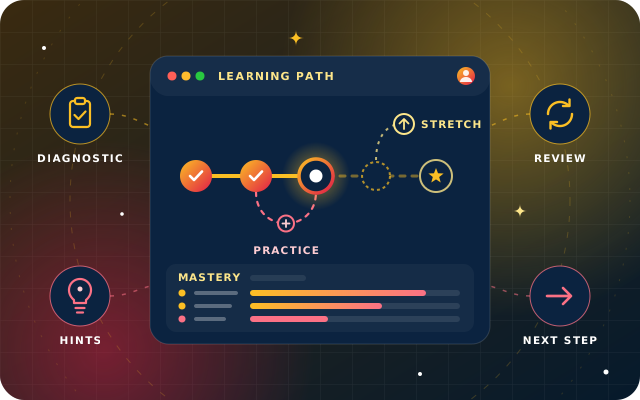
An adaptive platform treats each employee as a profile of skills rather than a list of courses to finish. The engine that personalizes learning in a classroom does the same work here: it estimates mastery per skill from every answer, chooses the next activity and schedules review when knowledge is likely to fade.
Aspect
Course-based training
Adaptive, competence-based training
Starting point
Everyone starts at module one
A short diagnostic places each person on their path
Content
The same content for every role
A shared core plus role-specific paths
Pace
A fixed timetable
Moves on when a skill is mastered
Assessment
One quiz at the end
Short checks throughout, scored per skill
Compliance
One long annual course
Short refreshers spaced through the year
Reporting
Completion rates and scores
Mastery per skill, gaps and overdue refreshers
Manager's question
Who has finished?
Who is ready, and who needs help with what?
Role-Based Onboarding Paths
Good onboarding paths are built from competencies, not from whichever courses you happen to own. Start with what someone in the role must be able to do by the end of onboarding, then work backwards to the skills and knowledge behind each task.
Most organizations end up with three layers:
A shared core for everyone: the organization and its values, health and safety, information security and the systems every employee uses.
A role path for each job family, such as warehouse operations, customer service, sales or finance, covering its procedures, products and tools.
A site or team layer for local procedures, equipment and contacts, so a branch or a plant can add what is specific to it without rewriting the rest.
Because the layers share one skill map, an employee who moves from customer service to sales keeps the skills they have already shown and works only on the gaps for the new role. It is also how a skills matrix stays current: it updates from evidence instead of an annual self-assessment.
Have a question about this guide? Ask the engineers who wrote it.
Diagnostics That Let People Skip What They Already Know
The quickest win in adaptive onboarding is the diagnostic. A short adaptive assessment at the start of each module samples its skills, and anyone who shows mastery moves straight on to the next gap. Experienced hires stop sitting through what they know, and newcomers get more time on the basics.
A few rules keep diagnostics fair and trusted:
Keep them short. An adaptive assessment should stop asking about a skill once the evidence is clear, rather than running a fixed number of questions.
Test application, not recall. Scenario questions, such as which step comes next or what to say to a customer, show competence better than definitions do.
Make skipping safe. Skipped content stays available, and spaced review later confirms that the skill is still there.
Separate learning from appraisal. If a diagnostic feels like a performance review, people guess or game it. Present it as a way to save their time.
Take a customer service coordinator who joins with years of experience elsewhere. Her diagnostic shows that she handles complaints and written replies well, so those modules are skipped. It shows gaps in the company's returns policy and its ticketing system, so her path starts there. Her manager sees the same picture on day one and pairs her with a colleague for the system training, rather than booking her onto the full induction.
Compliance Refreshers and Microlearning That Stick
Compliance training is where completion thinking does the most damage. A long annual course is clicked through to meet a deadline, and without practice much of the detail fades. Memory researchers have charted that decline since Hermann Ebbinghaus in the 1880s, and a modern replication of his forgetting curve produced results similar to his original data.
Spaced practice is the best-studied answer. A large meta-analysis of verbal recall studies by Cepeda and colleagues found that the gap between study sessions that gives the best retention grows as the time you need to remember something grows. For knowledge that must last all year, that points to short checks spread across the year rather than one long session. In practice that means:
Replacing the single annual course with short refreshers of a few questions each, scheduled through the year.
Drawing questions from randomised pools, so answers are harder to memorize and pass around.
Targeting refreshers by skill, so someone who answers fire safety questions confidently and correctly needs fewer checks than someone who hesitates.
Keeping a record of every attempt and certificate, so you can show who was trained, on what and when.
Microlearning: Short Does Not Mean Shallow
Microlearning means lessons of a few minutes each, often taken on a phone between tasks. It works when each piece teaches one skill, ends with practice and leads to the next step. It fails when a long course is simply chopped into clips. Adaptive sequencing gives microlearning its structure, because each short lesson is chosen for the gap the learner has right now.
Manager Dashboards That Show Competence
Managers do not need another report of who has logged in. They need to know who is ready to work alone, who needs help and with what. A useful team dashboard shows:
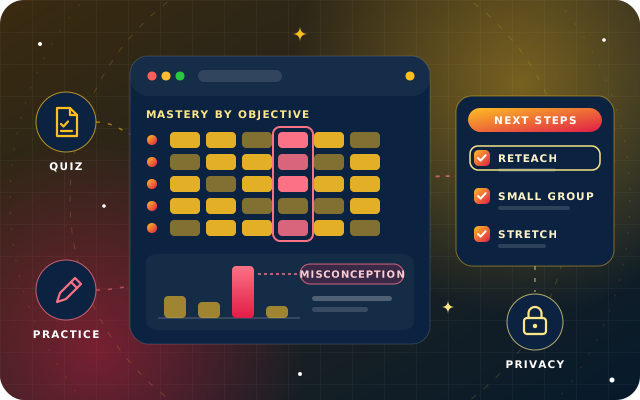
Mastery by skill for each team member, as a heatmap a manager can scan in seconds.
Progress along the onboarding path, with the skills still to master.
At-risk flags for inactivity, low mastery or repeated errors on the same skill.
Refreshers that are due or overdue, by person and by topic.
Certificates issued, and when they need renewing.
Notes on the coaching given, recorded alongside the data.
Two principles keep dashboards useful and fair. Every signal should lead to an action, such as pairing someone with a colleague, booking a practical session or adjusting a path. And access should follow the role: a manager sees their own team, HR sees what it needs across the organization, and individual results are never posted for everyone to compare.
Over time, the competence view also gives you a better onboarding measure than completion: time to competence, meaning how long a new hire takes to master the skills their role needs. Unlike a completion rate, it is a number the business genuinely cares about.
Your First Adaptive Onboarding Path, Step by Step
Pick one role. Choose a role you hire for regularly and whose tasks are clear, such as customer service or warehouse operations.
List the competencies. With the team lead, write down what someone must be able to do by the end of onboarding.
Map skills and prerequisites. Break each competency into skills and note which ones must come first.
Tag the content you have. Link existing slides, videos, procedures and question banks to those skills, and note the gaps.
Write scenario questions. Build a pool of questions at different levels of difficulty for each skill, including the diagnostic.
Agree what mastery means. Decide which skills need a practical sign-off from a supervisor as well as quiz evidence.
Pilot with one intake. Run the path with the next group of hires, gather feedback every week and tune the skill map.
Roll out role by role. Add the next role path, reusing the shared core and any skills that overlap.
Tip: Before launch, ask a few experienced people in the role, and a few people from other teams, to take the diagnostic. The experienced staff should pass and the others should not. If either group surprises you, the questions are testing the wrong things.
How Star Bit Solutions Can Help
StarLearn, our adaptive learning platform, is configured for vocational and corporate training as well as schools. For onboarding, compliance and skills programs, it builds each person's profile from a placement assessment, estimates mastery per skill with every answer and recommends the next lesson for that person alone. Adaptive assessments shorten once mastery is clear, so people who already know the material move on, and spaced review brings back skills that are at risk of fading.
Questions range from multiple choice to ordering and matching, drawn from randomised pools, and certificates are issued when a path or course is completed. Trainers see cohort progress, a skill heatmap, time on task and at-risk flags, record intervention notes per learner and export reports for leadership. The interface works in Arabic and English, and your existing slides, videos and question banks are imported and tagged by skill. If your HR runs on StarBiz, our AI-driven ERP, its HR module holds onboarding checklists, appraisals and a skills matrix, and StarBot can answer learners' questions on the web and WhatsApp and remind them of due tasks.
We start by mapping your competency framework or training plan to skills and prerequisites, then run a pilot with one training group before rolling out in waves. Contact us or call +971 55 973 4524 to plan a pilot around one role you hire for often.
Written by the Star Bit Solutions team
Star Bit Solutions is a software company in Ajman, UAE, founded in 2014. We implement and customize Odoo Enterprise and Odoo Community, and build StarBiz (AI-driven ERP), StarHub (life super app), StarBot (conversational AI), StarLearn (adaptive learning) and StarSense (AI and IoT platform). About us
A plain-language guide to adaptive learning: mastery estimates, diagnostics and spaced practice, the data behind them, the teacher's role and the pitfalls to avoid.
The quiz signals that matter, dashboards that lead to action, interventions that close gaps and how to protect young learners' data without sliding into surveillance.
Language switching, Gulf dialect, Arabizi, right-to-left layouts, tone and bilingual handover: a practical design guide for Arabic and English chatbots.
It is training that adjusts to each employee. A platform estimates what the person already knows, skill by skill, from short diagnostics and their answers as they work, then chooses the next lesson, practice or review for them. Experienced staff skip what they have already mastered, newer staff get more support, and managers see competence per skill rather than course completion.
Can employees skip training they already know?
Yes, if they can show it. A short adaptive diagnostic at the start of a module samples its skills, and anyone who demonstrates mastery moves on to the next gap. Skipped content stays available, and spaced review later checks that the skill is still there. For safety-critical skills, many organizations also require a practical sign-off by a supervisor.
How often should compliance refreshers run?
There is no single right interval, and some regulations set their own. Research on spaced practice suggests that the gap between reviews should grow with how long the knowledge must last, so short checks spread through the year are a better fit than one long annual course. An adaptive platform can also target refreshers by skill, giving more checks to people who hesitate.
What is microlearning and does it work?
Microlearning means short lessons of a few minutes, often taken on a phone. It works well when each piece teaches one clear skill, ends with practice and connects to the next step, and when the sequence adapts to what the learner still needs. It works poorly when a long course is simply cut into clips with no practice or structure.
What should a manager's training dashboard show?
It should show who is ready and who needs help, not just who has logged in: mastery by skill for each team member, progress along the onboarding path, at-risk flags for inactivity or repeated errors, refreshers that are due or overdue, and certificates with their renewal dates. Each manager should see only their own team.
StarLearn by Star Bit Solutions
Train for Competence, Not Completion.
Tell us about one role you hire for regularly. We will map it to skills and show you a StarLearn onboarding path built around it.