HVAC Predictive Maintenance: Keeping Chillers Running in UAE Buildings
Star Bit Solutions10 min read
Few building systems matter more in the UAE than cooling. This guide to HVAC predictive maintenance covers the chiller readings that matter, the fault patterns they reveal, how to route alerts to facilities teams and how to tie them to maintenance schedules.
UAE buildings need cooling for most of the year, in heat, dust and humidity, so early warnings from chillers, pumps and air handling units are worth acting on.
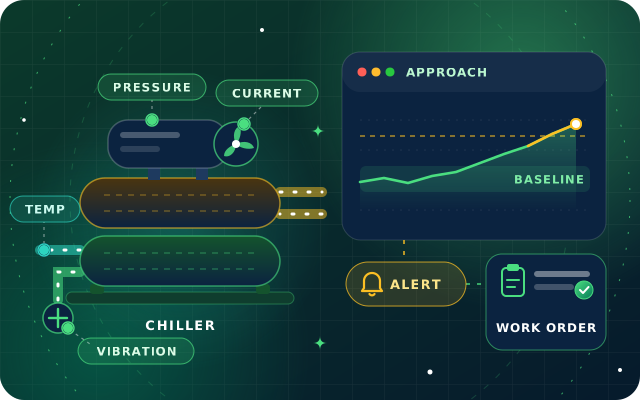
Start with temperatures, compressor current, refrigerant pressures, run hours and vibration; the controller or building management system often has them.
Watch derived values such as delta T and approach temperatures: a slow drift at the same load reveals fouling, leaks and flow problems early.
Route alerts by severity, with quiet hours, acknowledgment and escalation, and send each one with the reading, its baseline and the first check.
Keep the planned maintenance calendar, let confirmed alerts raise work orders or bring tasks forward, and use technician feedback to improve models.
When a chiller trips on a July afternoon in Dubai or Ajman, nobody needs a dashboard to notice. Tenants call, guests complain, and in a hospital or a server room the problem quickly becomes urgent. Yet many cooling failures announce themselves well before they happen, in temperatures, pressures, currents and vibration that nobody was watching.
HVAC (heating, ventilation and air conditioning) predictive maintenance is the practice of watching those signals and acting on them while there is still time to plan. If you are new to the approach, start with our explainer on predictive maintenance, from sensor readings to work orders.
Why HVAC Predictive Maintenance Matters in UAE Buildings
In much of the world cooling is seasonal. In the UAE it runs for most of the year, through long summers of high heat, coastal humidity and dust. Chillers, cooling towers, pumps and air handling units work hard for months, and when one fails the effect is immediate.
Three local conditions shape the faults you will see. Dust and sand load air filters and coat the fins of air-cooled condensers. High outdoor temperatures leave less margin before a chiller reaches its limits. And many buildings take chilled water from a district cooling provider. The chillers then sit off site, and the energy transfer station that connects the building to the network is often the provider's equipment under the supply agreement. The secondary pumps, air handling units and fan coil units still belong to the building's own team.
Planned preventive maintenance (PPM) on a calendar, often defined in an annual maintenance contract, remains essential. Predictive maintenance adds a second trigger: the measured condition of each asset. The US Department of Energy's Operations and Maintenance Best Practices Guide describes it as defining maintenance tasks by quantified equipment condition rather than by time alone, and its sample chiller log is a useful checklist of readings.
The Sensor Points That Matter on a Chiller
You do not need hundreds of points per chiller. A focused set, recorded continuously, covers most of the faults that matter:
Reading
Where
What it tells you
Chilled water supply and return temperature
Evaporator inlet and outlet, or the building side of an energy transfer station
Delta T, the difference between return and supply, and with flow, the cooling load
Condenser water or ambient air temperature
Condenser inlet and outlet, or the air intake of an air-cooled unit
How well heat is being rejected
Compressor current, per phase
Motor feed or starter
Load, phase imbalance and motor or electrical problems
Refrigerant suction and discharge pressure
Chiller controller
Saturation temperatures, approach temperatures, charge and non-condensables
Vibration
Compressor, pump and fan bearings
Wear, misalignment, imbalance and looseness
Run hours and starts
Chiller controller or current sensing
Usage-based servicing and short cycling
Oil pressure and temperature
Compressor lubrication circuit
Lubrication health on larger compressors
Water flow or pressure drop
Across the evaporator and condenser
Blocked strainers, closed valves, weak pumps and fouled tubes
Electrical power
Chiller and plant meters
Efficiency, in kilowatts (kW) per ton of refrigeration
Derived Values Carry Most of the Signal
Raw readings move with the weather and the load. The values calculated from them are what reveal a developing fault:
Delta T: chilled water return temperature minus supply temperature.
Evaporator approach: leaving chilled water temperature minus the saturated evaporating temperature of the refrigerant.
Condenser approach: saturated condensing temperature minus leaving condenser water temperature.
Efficiency: electrical input per ton of cooling delivered, compared at similar loads.
Current imbalance between the three phases, and starts per hour.
Compare each value with the manufacturer's design data and, more usefully, with the chiller's own history at similar load and outdoor conditions.
Common Chiller Fault Patterns and How They Show up
Each common fault leaves a recognizable fingerprint in the data, usually as a slow drift rather than a sudden jump:
Condenser fouling. Condenser approach widens at similar loads, with higher discharge pressure and compressor current. In water-cooled units the cause is scale or biological growth in the tubes. In air-cooled units it is dust and debris on the coil, and the gap between condensing temperature and outdoor air temperature widens instead.
Cooling tower and condenser water problems. Water leaves the cooling tower warmer than the outdoor wet-bulb temperature would suggest, or condenser water flow falls. Check fans, fill, strainers, pumps and water treatment.
Evaporator fouling or low chilled water flow. Evaporator approach widens and the pressure drop across the evaporator changes.
Refrigerant leak or low charge. Suction pressure and evaporating temperature fall, evaporator approach widens, and the chiller struggles to hold its setpoint at high load.
Non-condensable gases. Condensing pressure is higher than the condenser water temperature explains, and on low-pressure chillers the purge unit runs more often.
Low delta T. Return water comes back only slightly warmer than supply, so pumps move more water and extra chillers start early. Dirty coils, faulty control valves and wrong setpoints at air handling units are common causes.
Short cycling. Frequent starts with short run times, from low load, control problems or low charge. It is hard on compressors and contactors.
Mechanical wear. Vibration rises on compressor, pump or fan bearings, sometimes with rising bearing or motor temperature.
Electrical faults. Current imbalance between phases, rising motor temperature or repeated nuisance trips.
Sensor faults. Flat-lined, drifting or biased sensors. A labeled research dataset of HVAC faults includes sensor bias alongside fouling and stuck valves, and for good reason: a biased sensor can hide a real problem or invent one.
Have a question about this guide? Ask the engineers who wrote it.
From Readings to Alerts: Limits, Baselines and Anomaly Scores
Chiller controllers already protect the machine with hard limits such as high discharge pressure, low evaporator temperature and low oil pressure. Those trips prevent damage, but they arrive at the moment the cooling stops. Predictive maintenance works earlier, in three layers:
Fixed limits and rate-of-change rules for safety and obvious failures, such as a supply temperature rising quickly or a sensor going silent.
Per-asset baselines that learn what normal looks like for each chiller at each load and outdoor condition, so a reading that is fine on an August afternoon but odd on a January night stands out.
Anomaly scores that combine several readings and rise gradually as an asset drifts from its baseline, well before a hard limit is reached.
Every alert should be confirmed or dismissed by the technician who checks it. That feedback separates real wear from noise and, over time, tunes the models to your own equipment.
Routing Alerts to the Right Facilities Team
An alert nobody reads is worse than no alert, because it creates false confidence. Route by severity, and decide who receives what, on which channel and at which hours:
Critical, such as a chiller trip, loss of chilled water flow or a refrigerant alarm in the plant room: notify the on-call technician and supervisor at once, and escalate to a second contact if nobody acknowledges within the time you agree.
Warning, such as a widening approach or rising vibration: notify the asset owner during working hours and create a work order for planned attention.
Information, such as a run-hour threshold reached: add the task to the service plan without waking anyone.
Make each alert actionable. Name the asset and its location, show the reading against its baseline, list the likely causes and the first check to make. Merge repeats so one fault produces one alert, keep non-urgent messages inside quiet hours, and track acknowledgment so you know who saw what. If an FM (facilities management) contractor or the chiller manufacturer's service team maintains the plant, agree which alerts go to them directly and how they report back, so the history stays in one place.
Linking Alerts to Maintenance Schedules and Work Orders
Predictive maintenance pays off when alerts turn into planned work. A few rules keep the two systems in step:
Keep the PPM calendar, the manufacturer's tasks and anything your warranty or service contract requires. Condition data adds work or brings it forward; it should not quietly remove required checks.
Drive usage-based tasks from run hours and starts rather than from the calendar alone.
Raise a work order from every confirmed alert, with the readings and trend attached, so the technician arrives with the right tools and parts.
Plan intrusive work, such as tube cleaning, for low-load windows: nights, weekends and the cooler months.
Record what was found, what was done and what it cost, building a history per asset for repair-or-replace decisions.
A Worked Example: A Condenser That Slowly Fouls
Here is how the pieces fit together on a water-cooled chiller plant in a mixed-use tower.
Baseline. Over the first weeks, the platform learns chiller 2's normal condenser approach, discharge pressure and current at each load and condenser water temperature.
Drift. Over the following weeks, the condenser approach creeps up. Discharge pressure and compressor current rise at the same cooling load. Every value is still inside the controller's limits, so no alarm sounds.
Alert. The anomaly score crosses the warning level. The facilities engineer receives a WhatsApp alert with the reading against its baseline and the likely causes: tube fouling, low condenser water flow, a cooling tower problem or non-condensables.
Triage. Condenser water flow and the tower look normal, but the water treatment log shows a gap in chemical dosing. Fouling becomes the leading explanation.
Work order. A work order for tube inspection and cleaning is raised with the readings attached, and the annual tube cleaning in the PPM calendar is brought forward to a low-load night.
Confirm and learn. After cleaning, the approach returns to its baseline. The technician marks the alert as confirmed, and the asset history records the cause, the work and the cost.
A Checklist to Start with One Chiller Plant
List your critical cooling assets and what each one serves: tenants, guest rooms, data rooms, cold rooms or clinical areas.
Collect what you already have: chiller controller points, BMS (building management system) trends, energy meters, log sheets and maintenance history.
Agree the readings per chiller from the table above, and the derived values you will calculate.
Fill the gaps with sensors, typically vibration on pumps and tower fans, current clamps and flow or pressure drop.
Define severity levels, recipients, quiet hours and escalation, including out of hours and contractors.
Connect confirmed alerts to work orders and the PPM calendar.
Review every alert with technicians each month, and confirm or dismiss it so the models improve.
Tip: Before you trust a trend, check the sensors behind it. During routine visits, compare key temperatures and pressures with a calibrated handheld instrument, and flag any sensor that flat-lines or disagrees with its neighbors. A drifting sensor can make a healthy chiller look faulty, or hide a real fault.
How Star Bit Solutions Can Help
StarSense, our AI and IoT (internet of things) platform, is built for this work. Its gateways speak MQTT, Modbus, BLE (Bluetooth Low Energy) and LoRaWAN and read existing building management systems and meters, adding wireless sensors only where there is a gap. Models learn per-asset baselines from vibration, temperature, current and cycle data, anomaly scores rise before hard thresholds are crossed, and run-hour and cycle counters drive usage-based servicing.
Alerts reach your team by email, in-app notification and WhatsApp through StarBot, with severity levels, quiet hours, acknowledgment tracking and escalation to a second contact. Maintenance work orders can be raised automatically in StarBiz or your existing CMMS (computerized maintenance management system), and technicians confirm or dismiss each alert to retrain the models. For portfolios and districts, see how the same approach supports Smart Cities and IoT. Book a free site survey through our contact page, call +971 55 973 4524 or email [email protected].
Written by the Star Bit Solutions team
Star Bit Solutions is a software company in Ajman, UAE, founded in 2014. We implement and customize Odoo Enterprise and Odoo Community, and build StarBiz (AI-driven ERP), StarHub (life super app), StarBot (conversational AI), StarLearn (adaptive learning) and StarSense (AI and IoT platform). About us
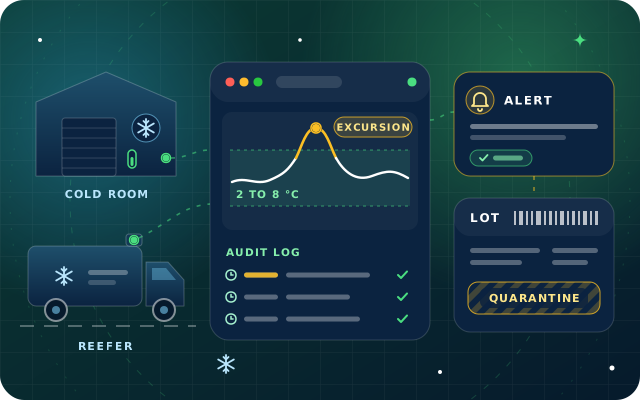
Sensors for cold rooms, reefers and fridges, alerting and escalation, tamper-evident records, calibration and tying each excursion to the lots it affected.
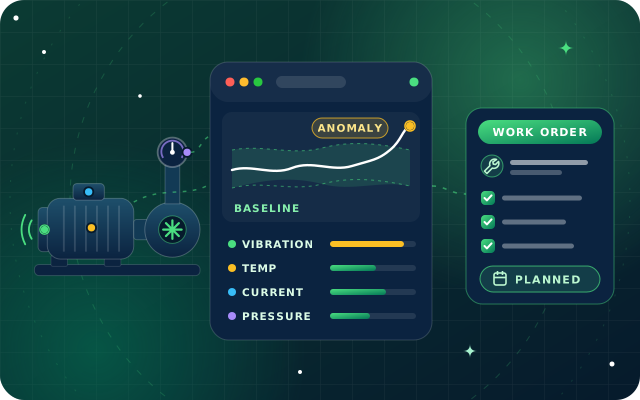
Maintenance strategies compared, the sensors that matter, baselines and anomaly detection in plain terms, alert thresholds and the loop to work orders.
What sensors do you need for chiller predictive maintenance?
Start with chilled water supply and return temperatures, condenser water or ambient air temperatures, compressor current per phase, refrigerant suction and discharge pressures, run hours and starts, and vibration on compressors, pumps and fans. Many of these already exist in the chiller controller or building management system, so add new sensors only where a survey finds a gap.
Can predictive maintenance use data from an existing building management system?
Usually, yes. Chiller controllers and building management systems already record many of the temperatures, pressures, currents and run hours that predictive models need. A gateway can read those points and combine them with a few added sensors, such as vibration on pumps or current clamps. The first step is a survey of which points exist and how often they are recorded.
What is chiller approach temperature and why does it matter?
Approach is the gap between the refrigerant's saturation temperature and the water leaving a heat exchanger. Condenser approach is the saturated condensing temperature minus the leaving condenser water temperature, and evaporator approach is the leaving chilled water temperature minus the saturated evaporating temperature. A slowly widening approach at similar loads usually points to fouling, low water flow or refrigerant problems.
Does predictive maintenance replace planned preventive maintenance?
No. Keep the planned preventive maintenance calendar, the manufacturer's tasks and anything your warranty or service contract requires. Predictive maintenance adds a second trigger based on measured condition: it brings work forward when a trend shows wear and supports better repair-or-replace decisions. The two work best when both feed the same work order system.
Is predictive maintenance useful in buildings on district cooling?
Yes. The chillers, and often the energy transfer station, belong to the district cooling provider, but the building still runs its secondary pumps, air handling units and fan coil units. Monitoring building-side supply and return temperatures, pump vibration and current, and air handling unit performance catches problems such as low delta T, failing pumps and blocked filters before tenants feel them.
StarSense by Star Bit Solutions
Hear from Your Chillers before Your Tenants Do.
Book a free site survey. We will map your cooling plant, check which readings you already have and propose a StarSense pilot on your most critical assets.