Predictive Maintenance Explained: From Sensor Readings to Work Orders
Star Bit Solutions10 min read
Predictive maintenance uses data from your own equipment to plan repairs before a failure stops production. Here is how it compares with other strategies, which sensors matter, how alerts stay useful and how they become work orders.
Predictive maintenance acts on trends in an asset's own data, so repairs are planned before a failure rather than after it or on a fixed calendar.
Vibration, temperature, current and pressure cover most rotating equipment. Choose sensors by the failures you need to catch.
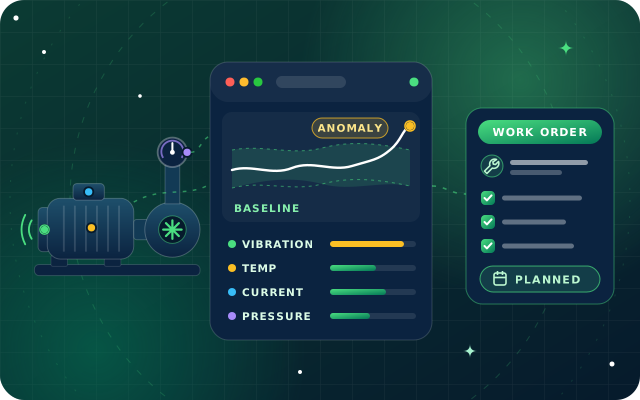
A baseline describes normal behavior for each asset and operating state, and an anomaly score measures how far readings drift from it.
Tiered thresholds, persistence delays and a named owner per alert keep alerts few, meaningful and acted on.
The value appears when an alert becomes a work order with readings, parts and history attached, and technician feedback flows back.
Many machine failures announce themselves long before the machine stops. A bearing vibrates a little more each week, a motor draws a little more current for the same load, a pump takes longer to reach pressure. Predictive maintenance is the discipline of noticing those signals early enough to plan the repair, instead of discovering the problem when a line stops or a chiller trips on the hottest afternoon of the year.
This guide explains predictive maintenance in plain terms: how it compares with other strategies, which sensors matter, how baselines and anomaly detection work, how to set alerts people will trust and how an alert becomes a work order in your ERP.
Four Maintenance Strategies Compared
Most sites use a mix of approaches, and the useful question is which one suits each asset. The US Department of Energy's Operations and Maintenance Best Practices Guide describes the same family, from run-to-failure through to reliability-centered maintenance, which combines them.
Strategy
When work happens
Strengths
Weaknesses
Good fit
Reactive
After a failure
No planning or monitoring effort
Unplanned downtime, overtime, knock-on damage
Cheap, non-critical items with spares on the shelf
Preventive
On a calendar or usage count
Simple to plan and audit
Parts replaced while still good; failures between services still happen
Wear items with predictable lives, statutory inspections
Condition-based
When a measurement crosses a limit
Work only when a condition demands it
Fixed limits miss slow drifts or fire too late
Assets with one clear indicator, such as filter pressure drop
Predictive
When trends suggest a failure is approaching
Longest warning, repairs planned around production
Needs data, history and a feedback loop
Critical rotating equipment where downtime is costly
Predictive maintenance does not replace preventive work. Lubrication, filter changes and statutory inspections still run on a schedule. What predictive methods decide is when the less predictable work happens.
How Predictive Maintenance Buys You Time
Reliability engineers talk about the P-F interval: the time between the point where a developing fault can first be detected (P, for potential failure) and the point where the asset actually fails (F, for functional failure). Where P sits depends on what you measure: a more sensitive signal reveals the same fault earlier, which leaves a longer interval to work with.
A long interval means you can order the part, book the technician and schedule the job into a planned stop. A short one means overtime, express freight and a production plan rewritten at short notice. Predictive maintenance is, in the end, a way of using that interval well: choosing measurements that detect P early, and checking often enough that a developing fault is never missed between readings.
Which Sensors Matter for Predictive Maintenance
Start from the failure you want to catch, then choose the measurement that shows it earliest. For most motors, pumps, fans and compressors, four measurements do most of the work.
Vibration
Accelerometers on bearing housings pick up imbalance, misalignment, looseness and bearing wear, often well before anything is audible or hot. The overall vibration level is a good first indicator, and frequency analysis tells a specialist which fault is developing.
Temperature
Temperature on bearings, motor windings, gearboxes and electrical connections reveals friction, overload and poor contact. In a bearing failure it tends to rise later than vibration, so it often confirms a problem rather than predicting it, but it is cheap and easy to read. In the UAE, readings must be interpreted against ambient temperature, which swings widely between winter and summer.
Electrical Current
A motor that draws more current for the same work is usually fighting something: a blocked impeller, a dragging bearing, a slipping belt or an electrical fault. Clamp-on current sensors fit inside the panel without touching the machine, which makes them a practical first sensor on equipment that is hard to reach.
Pressure and Flow
Pressure on pumps, compressors and hydraulic systems shows wear, leaks and blockages. A rising pressure drop across a filter or a coil means it is clogging, and a pump that delivers less pressure at the same speed is losing efficiency.
Run-hours and start counts complete the picture. They turn calendar-based servicing into usage-based servicing and give models context, because a reading during start-up means something different from the same reading at full load. Oil analysis, ultrasound and thermal imaging add depth for specific assets, usually as periodic checks rather than permanent sensors.
Have a question about this guide? Ask the engineers who wrote it.
A baseline is a description of what normal looks like for one particular asset. It is learned from that asset's own history, ideally across its operating states: starting, running at part load, running at full load and idling. Two identical pumps on different duties can have quite different baselines.
An anomaly score measures how far current readings sit from that baseline. A good model looks at several signals together, so a small rise in vibration combined with higher current and temperature scores higher than any one of them alone. It also tells two patterns apart: a slow drift, typical of wear, and a sudden step, typical of a breakage, a loose mounting or a faulty sensor.
Learn normal while the asset is healthy. A baseline recorded on a machine that is already failing teaches the model the wrong lesson.
Record the operating context. Load, speed, product and ambient temperature all change what normal looks like.
Expect the baseline to move. After a repair, a part change or a new production schedule, relearn it rather than fight it.
Worked Example: A Pump That Drifts
Take a cooling-water pump that runs most of the day. During its first weeks of monitoring, the platform learns its normal vibration and current at each flow rate. Months later, vibration starts to creep upward while current rises slightly at the same flow.
Neither reading crosses a fixed alarm limit, but together they push the anomaly score up for several days in a row. The maintenance planner sees the trend, checks the bearing at the next planned stop and replaces it before it seizes. Nobody had to stand next to the pump, and production lost nothing.
Alert Thresholds without Alert Fatigue
An alert nobody trusts is worse than no alert, because it teaches people to ignore the next one. Alert fatigue sets in when alarms fire too often, for the wrong reasons or for the wrong person. These rules keep alerts few and meaningful:
Use tiers. Advisory alerts go to the planner, warnings to the maintenance lead and critical alerts to whoever is on call.
Require persistence. A condition must hold for a set time before an alert fires, so start-up spikes and passing noise do not count.
Add hysteresis. Once an alert fires, it clears only when the reading falls clearly back below the limit, which stops it flapping on and off.
Watch the rate of change. A fast rise can matter more than the absolute value.
Alert on silence. A sensor that stops reporting tells you nothing about the asset, so silence needs an alert too. Heartbeats and last-seen times show when a device goes quiet.
Group related events. One fault that trips five sensors should produce one alert, not five.
Name an owner and an action. Every alert type needs a person who acts on it and a first check to make.
Review regularly. Look at which alerts were confirmed, which were dismissed and which limits need retuning.
Tip: start every new rule in dry-run mode. Let it evaluate live data and log what it would have sent for a trial period before anyone's phone rings. You will find the noisy rules before your technicians do.
Closing the Loop: From Alert to Work Order
Data does not fix machines; people with parts and time do. The loop closes only when an alert turns into scheduled work and the result flows back to the model.
Alert. The monitoring platform raises an alert with the asset, the readings that triggered it and a severity.
Triage. The maintenance lead confirms whether it is a real fault, a change in the process or a sensor problem.
Work order. A work order is created in the ERP or CMMS (computerized maintenance management system) against the asset, with priority, the triggering readings and the suggested checks.
Parts and scheduling. The planner reserves spare parts from stock, raises a purchase request if they are missing and books the job into a planned stop.
Execution. The technician records what they found using consistent cause codes, such as bearing wear, misalignment or lubrication.
Feedback. Confirming or dismissing the alert retrains the model, and labor and parts costs build the asset's history for repair-or-replace decisions.
Linking maintenance to the ERP matters because stock, purchasing, costs and production plans already live there. A work order that reserves the right bearing, and a production plan that knows the line will stop on Thursday morning, turn a developing fault into a routine job. If you run Odoo Enterprise or Community, its Maintenance app records equipment and both corrective and preventive maintenance requests, and a monitoring platform can feed it through an integration.
Start with One Critical Asset
The fastest way to prove the value of predictive maintenance is a pilot on one asset that matters, not a sensor on everything. A good first candidate ticks most of these boxes:
Its downtime is expensive, because it stops a line, a cold room or a building system.
It has failed before, or similar assets have, so you know which faults to look for.
Its spare parts have long lead times, so early warning buys real time.
It can be measured safely, with power and connectivity close by.
Someone owns it and will act on the alerts.
From there, the pilot follows a simple sequence: survey the site, fit sensors and a gateway, let the baseline build, run the rules in dry-run, connect work orders and review the first alerts with the technicians. When the loop works for one asset, roll the same device types out to similar ones.
The same thinking applies beyond machines. Our guide to what an AI-driven ERP actually does shows how anomaly detection flags unusual transactions in finance and stock in much the same way.
How Star Bit Solutions Can Help
StarSense, our AI and IoT platform, learns per-asset baselines from vibration, temperature, current and cycle data and raises anomaly scores before a hard limit is crossed. Its gateways speak MQTT, Modbus, BLE and LoRaWAN, so existing meters and controllers usually connect without replacement. Alerts reach people by email, in-app notification or WhatsApp through StarBot, with severity levels, escalation and acknowledgment tracking.
When an alert needs action, StarSense raises the maintenance work order in StarBiz, our AI-driven ERP, where spare parts, purchasing and asset costs share one data model, or in another CMMS through its REST API and webhooks. Technicians confirm or dismiss each alert, and that feedback improves the model over time.
For most manufacturers, a sensible starting point is the motors, compressors and pumps on the most critical line. See how we approach plants on our manufacturing industry page, then book a free site survey through the contact page, call +971 55 973 4524 or email [email protected]. We will help you choose the first asset and propose a pilot with a sensor list, before any commitment.
Written by the Star Bit Solutions team
Star Bit Solutions is a software company in Ajman, UAE, founded in 2014. We implement and customize Odoo Enterprise and Odoo Community, and build StarBiz (AI-driven ERP), StarHub (life super app), StarBot (conversational AI), StarLearn (adaptive learning) and StarSense (AI and IoT platform). About us
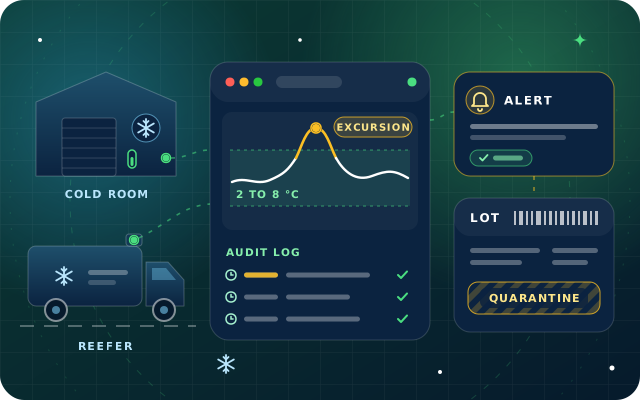
Sensors for cold rooms, reefers and fridges, alerting and escalation, tamper-evident records, calibration and tying each excursion to the lots it affected.
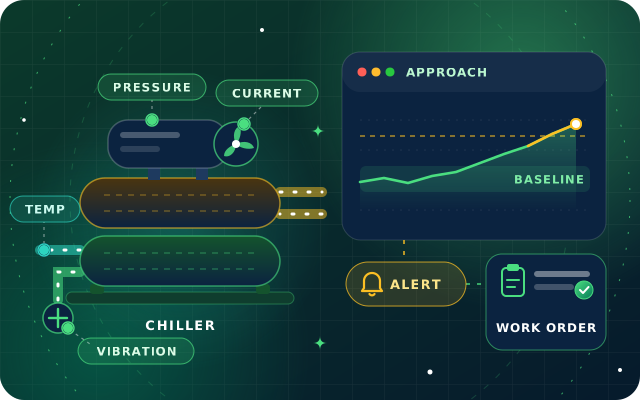
Sensor points, chiller fault patterns, alert routing and maintenance schedules: a practical guide to predictive maintenance for cooling plant in UAE buildings.
What is the difference between preventive and predictive maintenance?
Preventive maintenance happens on a fixed schedule or usage count, whatever the condition of the equipment. Predictive maintenance uses measurements such as vibration, temperature and current to estimate when an asset actually needs attention. Most sites use both: preventive work for routine tasks such as lubrication and filter changes, and predictive monitoring to time the less predictable repairs on critical equipment.
Which equipment benefits most from predictive maintenance?
Critical rotating equipment where downtime is expensive: motors, pumps, fans, compressors, gearboxes, chillers and air-handling units. The best candidates stop production or a building system when they fail, have a known failure history and use spare parts with long lead times. Cheap, non-critical items with spares on the shelf are usually better left to preventive or reactive maintenance.
Do we need machine learning to start predictive maintenance?
No. Many programs start with condition-based limits and simple trends on one or two measurements, which already give earlier warning than a calendar. Learned baselines and anomaly scores add value as history builds up, because they adapt to each asset and its operating states. What matters from day one is reliable data, alerts with clear owners and a route from alert to work order.
Can predictive maintenance work on older machines?
Usually, yes. Older equipment can be retrofitted with clamp-on current sensors, magnetically mounted vibration sensors and surface temperature probes, without modifying the machine. Gateways can also read controllers and meters that already speak protocols such as Modbus. A site survey shows which signals are available today and which assets need new sensors.
StarSense by Star Bit Solutions
Hear What Your Machines Are Telling You.
Book a free site survey. We will help you choose the first critical asset and propose a pilot with a sensor list, alert rules and the route to work orders.