UAE Gratuity Calculation: How Payroll Software Should Handle End of Service
Star Bit Solutions9 min read
A UAE gratuity calculation looks simple until salaries change, unpaid leave builds up or an employee passes five years of service. Here is how the rules work, and what your payroll software must store and accrue.
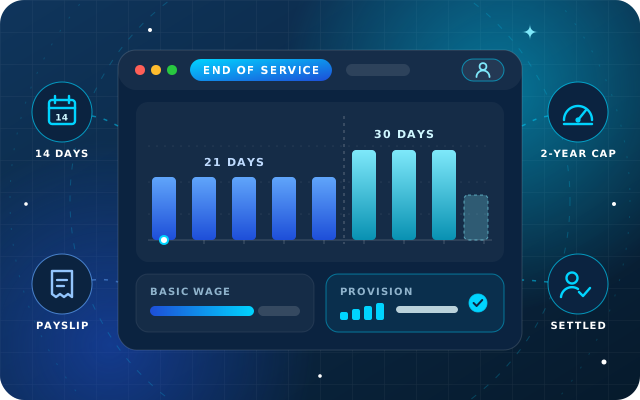
Gratuity is 21 days of basic wage for each of the first five years and 30 days for each year after, capped at two years' wage.
It is based on the last basic wage, excludes unpaid absence from service and must be paid within 14 days of the contract ending.
Most errors are data errors, so payroll needs joining dates, basic wage history, unpaid leave and the employee's scheme.
A monthly true-up of the provision captures pay rises that a fixed accrual rate misses until the employee leaves.
An employee's final settlement is one of the few payroll runs that everyone checks. The employee knows roughly what they are owed, the law sets a payment deadline, and a mistake surfaces as a complaint rather than a quiet correction. Yet the UAE gratuity calculation is where many payroll setups are weakest, because the formula is simple and the edge cases are not.
This guide explains the private-sector rules under Federal Decree-Law No. 33 of 2021 and its Executive Regulation, Cabinet Resolution No. 1 of 2022, as they stand in August 2025. It then works through an example and sets out what payroll software must store, and accrue, every month.
Not legal advice: this article summarizes published rules for private-sector employers under the federal labor law. Financial free zones such as DIFC and ADGM have their own employment rules, so check individual cases against MoHRE guidance or with a legal adviser.
The Rules behind a UAE Gratuity Calculation
Article 51 of the labor law sets out the end-of-service benefit for full-time foreign workers, and the UAE government portal summarizes the same rules.
Eligibility: at least one year of continuous service. Below that, no gratuity is due.
Rates: 21 days of basic wage for each of the first five years, and 30 days for each year after that.
Part years: once the first year is complete, part years count in proportion to the time served.
Unpaid absence: days of unpaid absence are left out of the service period.
Wage basis: the last basic wage, so housing, transport and other allowances are excluded.
Cap: the total cannot exceed two years' wage.
Deductions: the employer may deduct amounts due under the law or a court judgment, such as loans or overpayments, under the conditions in the Executive Regulation.
Timing: wages, gratuity and other entitlements must be paid within 14 days of the end of the contract.
UAE nationals are treated differently: their end-of-service benefits follow the pensions and social security legislation. Part-time and job-sharing workers receive a share of the full-time gratuity in proportion to their contracted hours, and temporary work of less than a year carries no gratuity.
Employers can also opt into the Savings Scheme, a voluntary alternative set up under Cabinet Resolution No. 96 of 2023, in which they pay monthly contributions into an approved investment fund instead of accruing the traditional gratuity. More on that below.
UAE Gratuity Calculation, Step by Step
Payroll software should follow the same sequence a careful HR officer would, and show its working at every step.
Confirm the scheme. Check whether the employee is a foreign worker on the traditional gratuity, a UAE national under the pension rules or a Savings Scheme member.
Measure the service. Count from the joining date to the last working day, then subtract days of unpaid absence.
Apply the one-year test. If continuous service is under one year, the gratuity is zero.
Work out the daily basic wage. The common convention divides the last monthly basic wage by 30.
Split the service at five years. Multiply the first five years by 21 days and any service beyond five years by 30 days, with part years in proportion.
Apply the cap. Limit the total to two years' wage.
Adjust for part-time work. Where it applies, multiply by contracted hours as a share of full-time hours.
Deduct lawful amounts. Subtract documented loans, advances or other amounts the Executive Regulation allows.
Pay on time. Settle within 14 days of the contract ending, and keep the calculation on file.
A Worked Example with round Numbers
Take a foreign employee with a last basic wage of AED 6,000 a month and a total package of AED 10,000 including allowances. They joined on 1 January 2018 and their last working day is 30 June 2025, which gives seven and a half years of service with no unpaid absence.
Step
Calculation
AED
Daily basic wage
6,000 / 30
200
First five years
5 x 21 days x 200
21,000
Remaining two and a half years
2.5 x 30 days x 200
15,000
Cap check
Two years' wage, far above the total
Not reached
Gratuity before deductions
36,000
Two variations show why the inputs matter. If the employee had taken 73 days of unpaid leave, a fifth of a year, the service would drop to 7.3 years and the gratuity to AED 34,800, because only 2.3 years attract the 30-day rate. If payroll had used the AED 10,000 package instead of the basic wage, it would have overpaid by AED 24,000.
The cap rarely bites. Even measured against basic wage alone, it is only reached after about 25 and a half years of service, but long-serving staff are exactly where a system without the rule goes wrong.
Have a question about this guide? Ask the engineers who wrote it.
What Payroll Software Must Store for Every Employee
Most gratuity errors are data errors: the formula is applied correctly to the wrong dates or the wrong wage. These are the fields to check in any payroll system.
Joining date and last working day, entered once and protected from casual edits.
Basic wage history with effective dates, kept separately from allowances, not only the current figure.
Unpaid leave and unpaid absence, linked to the leave types that exclude days from service.
Employment pattern, whether full-time, part-time or job-sharing, with contracted hours and the date of any change.
Scheme, whether the traditional gratuity, the pension rules for UAE nationals or the Savings Scheme, with the enrollment date.
Amounts owed by the employee, such as loans and advances, with the documents that support any deduction.
Settlement dates, so you can show that the final payment was made within 14 days.
Accruing the Gratuity Provision Every Month
Gratuity is earned month by month, so the cost belongs in each month's accounts rather than in the month someone resigns. The monthly entry debits an end-of-service expense account and credits an end-of-service provision, a liability. When the employee leaves, the payment is charged against the provision.
There are two common ways to calculate the monthly amount.
Question
Rate method
True-up method
How it works
A fixed monthly charge: basic wage / 30 x 21 / 12 in the first five years, and x 30 / 12 after
Recalculate each employee's full gratuity at month end and post the change in the provision
At AED 6,000 basic
AED 350 a month, then AED 500 after five years
Whatever the recalculated balance requires
Pay rises
Under-accrues, because past years are not repriced
Reprices past service in the month of the rise
Unpaid leave and the cap
Needs separate manual adjustments
Handled by the recalculation
Best suited to
Stable salaries and small teams
Businesses with regular pay reviews or an annual audit
The difference shows as soon as salaries move. Suppose our employee's basic wage rises from AED 6,000 to AED 7,500 on their fifth anniversary. The gratuity already earned for those five years jumps from AED 21,000 to AED 26,250, because it is always priced at the last basic wage. A true-up posts the AED 5,250 in that month, while a fixed rate leaves it hidden until the employee leaves.
For the financial statements, agree the method with your auditor. Companies reporting under full IFRS often measure the obligation under IAS 19, sometimes with an actuarial valuation, while many smaller businesses book the amount they would owe if every employee left at the reporting date. It is also one of the provisions to post before the year-end close in our Corporate Tax bookkeeping checklist.
Edge Cases to Test before You Trust the Numbers
Before go-live, and after every change to payroll rules, run these cases through the system and compare the results with a manual calculation:
An employee who leaves one day before, and one day after, completing their first year.
An employee who passes the five-year mark in the middle of a month.
A pay rise, and a pay cut, shortly before departure.
Unpaid leave spread across several years.
A move from full-time to part-time hours.
An employee with more than 25 years of service, to test the cap.
A Savings Scheme enrollment: the traditional accrual should stop for that employee, and the gratuity earned before enrollment must be calculated and settled as the law requires.
A final settlement with a loan deduction, paid within the 14-day limit.
For Savings Scheme members, the employer contribution for full-time employees is 5.83% of the monthly basic wage for those with under five years of service and 8.33% for those with more, transferred to the fund within 15 days of the start of each month. Payroll then needs to calculate the contribution and track its payment date, rather than accrue a gratuity.
How Odoo and StarBiz Handle End of Service
Odoo's UAE payroll localization is part of Odoo Enterprise Payroll. In Odoo 18, it includes an end-of-service salary rule that applies the 21-day and 30-day rates, and an end-of-service provision rule that sets aside a monthly amount without showing it on the payslip printout or changing net pay. By default, the daily wage is the monthly basic wage divided by 30, and you can set an actual daily salary on the contract instead. The UAE chart of accounts includes an End of Service Provision liability account and an End of Service Indemnity expense account for the postings.
Odoo's provision rule follows the rate method, so plan a periodic true-up journal, or an adjusted rule, if salaries change during the year. As with any system, test the end-of-service rule against the edge cases above before relying on it.
In StarBiz, our AI-driven ERP, the HR and payroll module covers salary structures, allowances and deductions, payslips and end-of-service inputs, and a payroll run produces both the payslips and the accounting entry in one step. Visa, contract and certificate expiries raise reminders weeks in advance, which helps keep employee records complete.
How Star Bit Solutions Can Help
We implement payroll on StarBiz and on Odoo Enterprise for UAE employers. A typical project includes:
loading joining dates, basic wage history and unpaid leave from your current records, and reconciling them with HR files;
configuring end-of-service rules, provisions and accounting entries around your policy and your auditor's method;
testing the edge cases in this article against manual calculations before go-live;
training HR and finance to run final settlements within the 14-day limit.
Star Bit Solutions is a software company in Ajman, UAE, founded in 2014. We implement and customize Odoo Enterprise and Odoo Community, and build StarBiz (AI-driven ERP), StarHub (life super app), StarBot (conversational AI), StarLearn (adaptive learning) and StarSense (AI and IoT platform). About us
Chart of accounts mapping, non-deductible costs, related parties, seven-year records and the year-end routine that gets your books ready for Corporate Tax.
Is UAE gratuity calculated on basic salary or total salary?
On basic salary. Article 51 of the labor law calculates the gratuity on the last basic wage the employee was entitled to, so allowances such as housing, transport, utilities and furniture are excluded. Payroll software should store the basic wage separately from allowances, with its full history.
When must an employer pay end-of-service gratuity in the UAE?
Within 14 days of the end of the employment contract. Article 53 of the labor law requires the employer to pay the worker's wages and all other entitlements, including the gratuity, within that period, so the calculation should be ready before the last working day.
Does unpaid leave reduce gratuity in the UAE?
Yes, indirectly. Days of unpaid absence are not counted in the service period, so they shorten the service used in the calculation. In our example, 73 days of unpaid leave reduce the gratuity for seven and a half years of service on a basic wage of AED 6,000 from AED 36,000 to AED 34,800.
How is gratuity calculated for part-time employees in the UAE?
Under Article 30 of the Executive Regulation, divide the contracted working hours per year by the full-time hours per year to get a percentage, then apply it to the gratuity a full-time employee would receive. Temporary work that lasts less than one year carries no gratuity.
What is the Savings Scheme for end-of-service benefits?
A voluntary alternative launched by MoHRE, in which employers pay monthly contributions into an approved investment fund instead of accruing the traditional gratuity: 5.83% of basic wage for employees with under five years of service and 8.33% after that. Employees are entitled to the contributions and any returns within 14 days after their employment ends.
StarBiz by Star Bit Solutions
Get Every Final Settlement Right, and on Time.
We configure end-of-service rules, salary history and monthly provisions in StarBiz or Odoo Enterprise Payroll, then test them against your own cases.