UAE Corporate Tax Accounting: A Checklist for Tax-Ready Books
Star Bit Solutions10 min read
UAE corporate tax accounting starts in everyday bookkeeping, not at year end. This checklist shows how to set up your accounting system so the Corporate Tax return is built from clean numbers you can prove.
UAE Corporate Tax starts from your accounting profit, so the quality of everyday bookkeeping decides how easy the return will be.
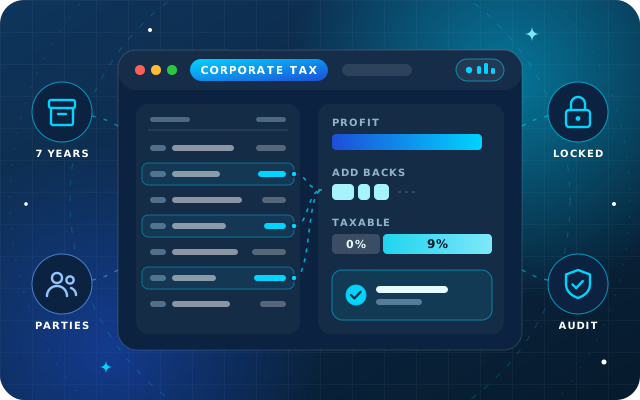
Give each tax adjustment its own account, such as client entertainment, fines, donations and interest, so add-backs come straight from the ledger.
Flag related parties and connected persons in the system, and keep evidence that their prices and salaries match market value.
Keep Corporate Tax records for seven years after each tax period, in a form you can retrieve even after changing systems.
Revenue drives key thresholds, including AED 3 million for small business relief and AED 50 million for audited statements.
If your financial year follows the calendar, your first UAE Corporate Tax period closed on 31 December 2024, and the return and payment are due by 30 September 2025. That sounds like plenty of time until you remember where the return starts: with the accounting profit in your financial statements. Good UAE corporate tax accounting therefore happens in daily bookkeeping, long before anyone opens the return on EmaraTax.
This checklist covers what the law asks of your books and how to set up your accounting system, whether StarBiz, Odoo or another ERP, so that every adjustment traces back to a ledger account.
Not tax advice: this article summarizes rules published by the Ministry of Finance and the Federal Tax Authority as of March 2025. Every business is different, so confirm your treatment with a registered tax agent before you file.
How UAE Corporate Tax Accounting Starts from Your Financial Statements
Corporate Tax applies to a business from the start of its first financial year beginning on or after 1 June 2023. Under Federal Decree-Law No. 47 of 2022, taxable income is your accounting income for the tax period, adjusted for items such as exempt income, non-deductible expenditure, transactions with related parties and tax losses.
For most businesses, the rate is 0% on taxable income up to AED 375,000 and 9% on the rest. The return must be filed, and the tax paid, within nine months of the end of the tax period.
Because the starting point is your accounts, the rules also say how those accounts are prepared. Financial statements follow IFRS, although businesses with revenue of AED 50 million or less may use IFRS for SMEs, and those with revenue of AED 3 million or less may use the cash basis. Revenue, in other words, is a figure your ERP must report precisely, because several thresholds depend on it.
Threshold
Measured on
What it changes
AED 375,000
Taxable income
Income up to this amount is taxed at 0%, and the rest at 9%
AED 3 million
Revenue
The cash basis is allowed, and resident businesses may elect small business relief
AED 50 million
Revenue
IFRS for SMEs is allowed up to this level, and audited financial statements are required above it
Small business relief is open to resident businesses whose revenue stays at or below AED 3 million in the current and every previous tax period, for tax periods ending on or before 31 December 2026. It is not available to Qualifying Free Zone Persons or members of large multinational groups, and because it is elected in the return, registration, records and filing still apply.
Every Qualifying Free Zone Person also needs audited financial statements, whatever its revenue.
Map Your Chart of Accounts to Tax Adjustments
The simplest way to make adjustments reliable is to give each one its own account, or at least its own analytic tag. When a cost that tax treats differently sits inside a general account, someone has to rebuild the add-back by hand at year end, usually from memory.
Review your chart of accounts against the items below, each of which needs its own home in the ledger.
Account to separate
Corporate Tax treatment
What to set up
Entertainment of customers, shareholders, suppliers and other business partners
50% deductible (Article 32)
A dedicated expense account, with staff events kept in a different account
Fines and penalties
Not deductible, except compensation for damages or breach of contract (Article 33)
Separate accounts for regulatory fines and contractual compensation
Donations, grants and gifts
Deductible only when made to a Qualifying Public Benefit Entity (Article 33)
A separate account, with the recipient recorded on every entry
Interest expense and interest income
Net interest above the higher of AED 12 million and 30% of EBITDA, as adjusted for tax, is restricted (Article 30)
Separate accounts, with related-party loans tagged
Corporate Tax expense and liability
Corporate Tax itself is not deductible (Article 33)
Dedicated tax expense, provision and payable accounts
Input VAT
Recoverable input VAT is not deductible (Article 33)
Recoverable VAT kept on the balance sheet, never in expense accounts
Dividends received
Dividends from UAE resident companies are exempt income (Article 22)
Income accounts split by source, resident and foreign
Unrealized gains and losses
Relevant if you elect the realization basis (Article 20)
Separate accounts for fair value and foreign exchange revaluations
Owner and personal costs
Only expenditure incurred wholly and exclusively for the business is deductible (Article 28)
An owner's current account, so personal costs never reach the profit and loss
Most of this is configuration, not custom code. Account groups keep the statements tidy, and analytic tags mark individual lines, such as a client dinner on a mixed agency invoice.
Capture Tax-Sensitive Costs at the Point of Entry
An account structure only works if transactions land in the right place, and the cheapest moment to classify a cost is when it is entered.
Expense categories with default accounts. Map categories such as client entertainment, government fines and donations to their own accounts, so staff choose a category rather than an account.
Required details on entertainment claims. Ask for the guests, their business relationship and the purpose, because that is the evidence behind the 50% deduction.
Receipts attached to the entry. Attach the invoice or receipt to the journal entry, bill or expense, so the evidence travels with the number.
Approvals for sensitive accounts. Route postings to fines, donations and owner accounts through an approval step with a recorded approver.
A monthly review. Run a short report of every tax-sensitive account each month, and correct misposted lines while people still remember them.
Have a question about this guide? Ask the engineers who wrote it.
Give Related Parties and Connected Persons Their Own Trail
Transactions between related parties must meet the arm's length standard (Article 34). Related parties include, for example, relatives up to the fourth degree, an individual and the companies they own 50% or more of or control, and companies under common ownership of 50% or more or common control (Article 35).
Connected persons are a separate group: any individual who directly or indirectly owns an interest in the business, its directors and officers, and their related parties. A payment or benefit to a connected person is deductible only to the extent it matches market value and is incurred wholly and exclusively for the business (Article 36), with exceptions for listed companies and businesses under regulatory oversight.
In the ERP, that means three things:
Flag the parties. Mark related parties and connected persons on partner and employee records, so their transactions can be listed in seconds.
Separate the flows. Use dedicated accounts or tags for intercompany sales and purchases, management fees, loans and director remuneration.
Keep the pricing evidence. Attach the contracts, price lists or benchmarks that show how each price or salary was set.
The authority can also require a disclosure of these transactions with the return (Article 55), and its guidance sets when that applies. Larger businesses, with revenue of AED 200 million or more, or part of a group with consolidated revenue of AED 3.15 billion or more, must also keep a master file and a local file. Check the latest guidance from the Federal Tax Authority for the current thresholds.
Keep Records for Seven Years, in a Form You Can Retrieve
Article 56 requires a taxable person to keep all records and documents that support the return, and that let the authority readily work out taxable income, for seven years after the end of the tax period they relate to. Exempt persons have the same seven-year duty for the records that prove their status.
In practice, that covers ledgers and journals, sales and purchase invoices, contracts, bank statements, payroll records, fixed asset registers, transfer pricing files and the workpapers behind each Corporate Tax computation. The Tax Procedures Executive Regulation, Cabinet Decision No. 74 of 2023, accepts electronic copies, provided they match the originals and a readable copy can be produced on request.
Backups must therefore be restorable for the full period, and replacing your ERP must not strand old records: if you migrate, keep read-only access to the old database or export complete ledgers and documents first.
A Year-End Close Routine for Corporate Tax
With the structure in place, the year-end close becomes a sequence rather than a scramble:
Reconcile bank, cash, receivables and payables, and clear any suspense accounts.
Post accruals, prepayments, depreciation and provisions, including staff end-of-service provisions.
Agree intercompany and related-party balances with the other side.
Review every tax-sensitive account and correct misposted lines.
Lock the period, so nothing changes after the numbers are agreed.
Produce the financial statements, and have them audited where required.
Build the Corporate Tax computation from accounting profit, line by line from the ledger.
Decide on elections, such as small business relief, with your tax agent.
Post the Corporate Tax provision, then file and pay within nine months.
Archive the computation, the statements and the supporting reports together.
Worked Example: From Accounting Profit to Taxable Income
Take a resident trading company with an accounting profit of AED 1,200,000 for the year. Its ledger shows AED 60,000 of client entertainment, AED 8,000 of traffic and government fines, and a AED 12,000 donation to a charity that is not a Qualifying Public Benefit Entity. There is no exempt income, interest restriction, related-party adjustment or loss brought forward.
Line
AED
Accounting profit
1,200,000
Add back 50% of client entertainment (60,000 x 50%)
30,000
Add back fines and penalties
8,000
Add back the donation to a non-qualifying entity
12,000
Taxable income
1,250,000
0% on the first 375,000
0
9% on the remaining 875,000
78,750
Corporate Tax payable
78,750
Every adjustment came straight from a dedicated account. Had the entertainment sat in general office costs, the add-back would have been an estimate, and estimates are what a tax audit questions first.
Report revenue by period and company from posted entries, with no adjustments made outside the system
Traceable adjustments
Dedicated accounts and analytic tags, with drill-down from each report line to the entries behind it
Related-party visibility
Flags on partners and employees, and reports that list their transactions
Evidence
Attachments on journal entries, bills and expenses
Closed periods stay closed
Lock dates, and an audit trail of who changed what and when
Statements and workpapers
Balance sheet, profit and loss and general ledger, exported to PDF or XLSX
StarBiz covers these in its finance core, with fiscal-year locks, period closing controls and a full log of changes. On Odoo, Enterprise Accounting provides lock dates, the full reporting suite and an audit trail that cannot be switched off once enabled, and the UAE localization includes a Corporate Tax report. Test that report against your tax agent's computation before you rely on it.
How Star Bit Solutions Can Help
Star Bit Solutions has built business software in Ajman since 2014. We do not prepare tax returns, but we build the books your tax agent works from.
StarBiz, our AI-driven ERP. Finance, sales, inventory, payroll and projects share one data model, with VAT and tax reporting at configurable rates, fixed assets, budgets and cost centers. See StarBiz.
Odoo Enterprise implementation. Through OdooStar, our Odoo practice, we implement Odoo Enterprise Accounting with a chart of accounts designed around these adjustments, and configure the UAE localization on your own transactions.
A review of your current setup. If you already run StarBiz or Odoo, we can review your chart of accounts and tax settings and propose changes before the year-end close.
Tell us how your books are organized today through the contact page, call +971 55 973 4524 or email [email protected], and we will suggest a structure your tax agent can work with.
Written by the Star Bit Solutions team
Star Bit Solutions is a software company in Ajman, UAE, founded in 2014. We implement and customize Odoo Enterprise and Odoo Community, and build StarBiz (AI-driven ERP), StarHub (life super app), StarBot (conversational AI), StarLearn (adaptive learning) and StarSense (AI and IoT platform). About us
Do I need audited financial statements for UAE Corporate Tax?
Under the Ministerial Decision in force in early 2025, audited financial statements are required for taxable persons whose revenue exceeds AED 50 million in the tax period, and for every Qualifying Free Zone Person. Other businesses may still need an audit under company law or their free zone's rules, so check with your auditor and a registered tax agent.
How long must UAE businesses keep Corporate Tax records?
Article 56 of the Corporate Tax Law requires taxable persons to keep the records and documents that support their tax return, and that let the authority readily work out taxable income, for seven years after the end of the tax period they relate to. Exempt persons must keep the records that prove their status for the same period.
Are entertainment expenses deductible for UAE Corporate Tax?
Entertainment, amusement and recreation costs for customers, shareholders, suppliers and other business partners are 50% deductible under Article 32, including meals, accommodation, transport and admission fees. Keep them in their own account and record who attended and why, so the add-back can be calculated directly from the ledger.
Can a small business use cash basis accounting for Corporate Tax?
Yes, if its revenue does not exceed AED 3 million, or in exceptional circumstances on application to the Federal Tax Authority. Businesses above that level prepare accrual-based financial statements under IFRS, or under IFRS for SMEs where revenue does not exceed AED 50 million.
What is small business relief under UAE Corporate Tax?
It lets a resident business elect to be treated as having no taxable income for a tax period if its revenue is AED 3 million or less in that period and every earlier one. As of early 2025 it covers tax periods ending on or before 31 December 2026, excludes Qualifying Free Zone Persons and large multinational groups, and is elected in the tax return.
StarBiz by Star Bit Solutions
Build Books That Are Ready for Corporate Tax.
We set up StarBiz or Odoo Enterprise with a chart of accounts mapped to tax adjustments, locked periods and a full audit trail, working alongside your tax agent.