UAE VAT and compliance
UAE Gratuity Calculation: How Payroll Software Should Handle End of Service
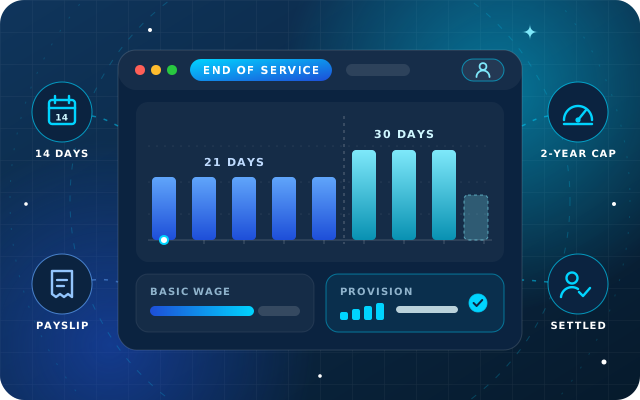
The legal rules, a worked example, the data payroll must keep and two ways to accrue the end-of-service provision every month.
· 9 min read
UAE e-invoicing now has a legal scope and a timetable. Here is what the two Ministerial Decisions published in September 2025 require, which invoices they cover and how to prepare your ERP and your data.
Key takeaways
Until recently, UAE e-invoicing was a direction of travel. On 29 September 2025 it became a set of rules with dates, when the Ministry of Finance announced two Ministerial Decisions. No. 243 of 2025 sets out who and what is covered and what issuers and recipients must do, and No. 244 of 2025 fixes the timetable.
This article summarizes both decisions as published, explains what they mean for the ERP that creates your invoices and credit notes, and ends with a preparation plan. If you only read one section, read the timeline: the largest businesses must appoint a service provider by 31 July 2026.
Not tax advice: this article reflects the decisions and guidance published by mid-October 2025. Further decisions, including the categories of excluded persons and the reporting timelines, are still to come, so check the latest guidance from the Ministry of Finance and the Federal Tax Authority, and confirm your position with a registered tax agent.
The groundwork was laid in October 2024, when Federal Decree-Laws No. 16 and No. 17 of 2024 amended the VAT and Tax Procedures laws to recognize electronic invoices and credit notes and to let the Minister set the detailed rules. Ministerial Decision No. 64 of 2025 then set the criteria for accrediting service providers.
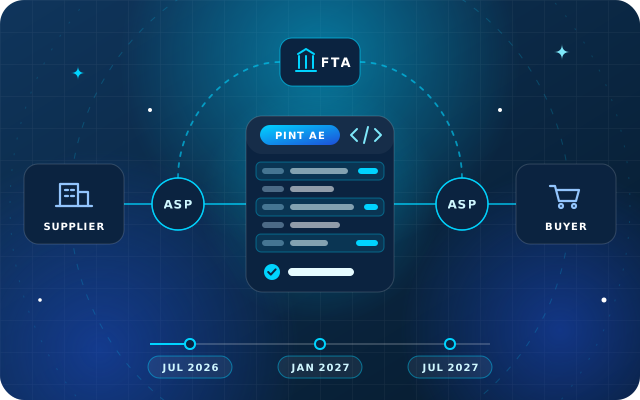
The model is decentralized, with five corners: the supplier, the supplier's accredited service provider (ASP), the buyer's ASP, the buyer and the Federal Tax Authority. Invoices travel between the two ASPs over the Peppol network, the international framework for exchanging business documents, and tax data is reported to the authority.
Under Decision 243, an electronic invoice is one issued, transmitted and received in a structured format that allows automatic processing, so a PDF attached to an email does not qualify. The UAE data format, PINT AE, was published on the Peppol documentation site in June 2025.
Decision 243 applies to any person conducting business in the UAE, for every business transaction, unless the person or the transaction is excluded. The test is doing business, not VAT registration. In practice, that means business-to-business and business-to-government invoices, because Decision 244 keeps business-to-consumer transactions out of the system until a later decision, and a business that sells only to consumers is not covered for now.
The excluded transactions are:
The categories of excluded persons will be set in a separate decision. Anyone excluded can still join voluntarily, in which case the rules apply in full, except those on violations and penalties.
Decision 244 starts with a pilot on 1 July 2026, run with a taxpayer working group that the Ministry selects and invites. From the same date, any business may implement e-invoicing voluntarily. Mandatory implementation then follows revenue.
| Who | Appoint an ASP by | Implement e-invoicing by |
|---|---|---|
| Businesses with revenue of AED 50 million or more | 31 July 2026 | 1 January 2027 |
| Businesses with revenue below AED 50 million | 31 March 2027 | 1 July 2027 |
| Government entities | 31 March 2027 | 1 October 2027 |
Revenue here means gross income in the most recent accounting period, based on your financial statements. A business close to AED 50 million should confirm early which group it falls into, rather than discover it in the summer of 2026.
Two examples make the dates concrete. A distributor with AED 80 million of revenue must appoint an ASP by 31 July 2026 and go live by 1 January 2027, which leaves about nine months from mid-October 2025 to choose a provider, integrate and test. A consultancy with AED 12 million of revenue has until 31 March 2027 to appoint an ASP, and until 1 July 2027 to go live.
An e-invoice is data first and a document second, so gaps in master data become rejected invoices. PINT AE defines which fields are mandatory, conditional or optional, and it adds UAE flags that classify the transaction: free trade zone, deemed supply, profit margin scheme, summary invoice, continuous supply, disclosed agent billing, supply through e-commerce and exports.
| Data area | What to check now |
|---|---|
| Customers and suppliers | Legal names, full addresses and tax registration numbers on every record, with no duplicates |
| Products and services | Clear descriptions, units of measure and a tax category on every item |
| Tax codes | Standard-rated, zero-rated, exempt, out of scope and reverse charge treatments mapped correctly |
| Transaction types | A way to mark free zone, deemed supply, margin scheme, summary, continuous supply, agent, e-commerce and export cases |
| Credit notes | A reference to the original invoice, and the reason for the credit, on every credit note |
| Currency | Amounts and VAT in AED, with the exchange rate applied, on foreign-currency invoices, as tax invoices already require |
| Supplier invoices | Purchase orders and goods receipts that incoming e-invoices can be matched against |
Much of this is already required for a valid tax invoice under Article 59 of the VAT Executive Regulation. The difference is that a missing field used to be a printing problem and will now be a validation failure.
For most businesses, the ERP will not talk to the authority directly. It will hand invoice data to an ASP and receive statuses and incoming invoices back. That creates a few new jobs for the system:
On Odoo 19, the UAE VAT201 report has been rebuilt on Odoo's newer reporting engine. Foreign-currency invoice PDFs also show the amount in the company's currency to comply with Article 59, a change the release notes mark as available from version 16. The same release notes list Peppol PINT support for Australia, New Zealand and Singapore, but not yet for the UAE, so plan for a connection to your chosen ASP. Our summary of what is new in Odoo 19 covers the other UAE changes.
StarBiz connects to outside systems through REST APIs and scheduled file exchange, and its purchasing already supports three-way matching, which is where incoming e-invoices pay off.
The deadlines leave enough time to do this calmly, but not enough to start late. A sensible sequence:
Your VAT routine does not stop in the meantime. Our UAE VAT return workflow covers the tax codes and reconciliations that e-invoicing will depend on.
Star Bit Solutions has built and implemented business software for UAE companies from Ajman since 2014. For e-invoicing, we can:
Tell us your revenue group and the systems you invoice from through the contact page, or call +971 55 973 4524, and we will outline a plan that meets your deadline.

Star Bit Solutions is a software company in Ajman, UAE, founded in 2014. We implement and customize Odoo Enterprise and Odoo Community, and build StarBiz (AI-driven ERP), StarHub (life super app), StarBot (conversational AI), StarLearn (adaptive learning) and StarSense (AI and IoT platform). About us
Invoicing, purchasing and finance on one data model, with REST APIs and scheduled file exchange for connecting outside systems.
Learn MoreOdoo Accounting configured for UAE VAT, with integrations and custom modules on Odoo.sh or your own servers.
Learn MorePayment gateways, e-commerce, banks and other systems connected to Odoo through its APIs and scheduled jobs.
Learn MoreThe legal rules, a worked example, the data payroll must keep and two ways to accrue the end-of-service provision every month.
· 9 min read
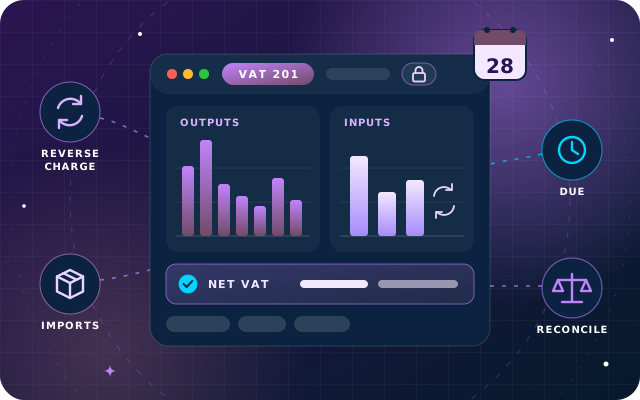
Tax codes, reverse charge, imports, credit notes, reconciliation and the 28th-day deadline: a quarter-end routine for filing an accurate VAT return.
· 10 min read

Chart of accounts mapping, non-deductible costs, related parties, seven-year records and the year-end routine that gets your books ready for Corporate Tax.
· 10 min read
Under Ministerial Decision No. 244 of 2025, businesses with revenue of AED 50 million or more must appoint an accredited service provider by 31 July 2026 and implement e-invoicing by 1 January 2027. Businesses below that line have until 31 March 2027 and 1 July 2027. Government entities follow on 1 October 2027, and a pilot and voluntary phase start on 1 July 2026.
Not for now. Decision 244 keeps business-to-consumer transactions outside the system until the Minister decides otherwise, and a business that deals only with consumers is not covered. Business-to-business and business-to-government transactions are in scope unless a specific exclusion applies, so a business with mixed customers still needs to prepare.
Potentially, yes. Decision 243 applies to any person conducting business in the UAE for every business transaction, unless the person or the transaction is excluded, so VAT registration is not the test. The categories of excluded persons are to be set in a later decision, so check the latest guidance before deciding you are out of scope.
No. Decision 243 defines an electronic invoice as one issued, transmitted and received in a structured electronic format that enables automatic processing. In the UAE model, that structured data is exchanged between accredited service providers over the Peppol network using the PINT AE specification, rather than emailed as a PDF.
PINT AE is the UAE version of the Peppol International invoice specification. Published on the Peppol documentation site in June 2025, it defines the structure, codes and validation rules for UAE e-invoices and credit notes, including flags for cases such as free zone supplies, deemed supplies, the profit margin scheme and exports.
We review your invoice data and tax codes in StarBiz or Odoo, plan the connection to your accredited service provider and test it before your deadline.