The Challenge
This grower packs its own harvest and sells it through several channels: wholesalers buy by the pallet, retailers by the crate, and hotels and restaurants by the kilo. Its previous accounting package needed a separate item for each pack size, so the stock of a single crop was split across codes that never agreed with the cold room. Sales staff converted crates to kilos by hand, and pricing errors crept in whenever a customer changed the way it ordered. Mixed units, untraced harvests and seasonal payroll are what growers raise most often when they ask us about Odoo for Agriculture and Agritech.
Traceability was just as manual. When a retailer queried a delivery, the team searched harvest sheets and delivery notes to work out which field and which harvest it came from, and a recall would have meant calling every customer. The seasonal workforce added another layer: pickers and packers joined for the season, attendance was recorded on paper sheets, and payroll was calculated in spreadsheets and then re-keyed into the accounts.
- One crop, many codes: stock split by pack size and never reconciled.
- No harvest traceability: no quick answer to where a delivery came from.
- Older stock left behind: no reliable way to send the oldest produce out first.
- Seasonal payroll by spreadsheet: paper attendance, manual calculations and double entry.
Our Approach
Discovery followed the produce from field to invoice, through harvest, packhouse, cold room, dispatch and billing, and then the payroll cycle for seasonal staff. Our OdooStar team recommended Odoo Enterprise, because Payroll, Barcode and full Accounting were all on the list of needs. The fit-gap showed that standard Odoo covered the core: units of measure and packagings for crates and pallets, lots with expiration dates for traceability, and Payroll with Attendances for seasonal staff. The main gap, recording which field each harvest came from, was closed with a property on the lot form, so the configuration stayed close to standard Odoo.
The rollout was planned around the growing calendar:
- Product master: the pack-size duplicates were merged into one product per crop and grade, with crate and pallet set up as packagings.
- Sales, stock and accounting: configured on a test database and rehearsed with real orders from the previous season.
- Lots and Barcode: lot naming, label printing and scanning were trialled in the packhouse before go-live.
- Payroll: contracts, salary structures and attendance were set up ahead of the peak season, and a trial payroll was checked against the old spreadsheet.
- Training: role-based sessions for sales, packhouse, HR and finance, plus administrator training on users and access rights.
The Solution
One Product, Sold by the Crate, Kilo or Pallet
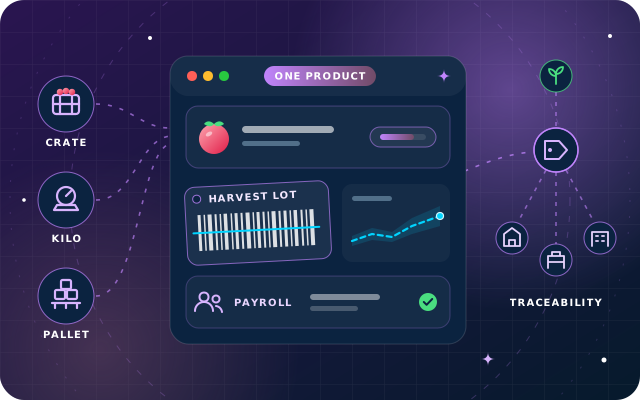
Each crop and grade is now a single product stocked in kilos, with crate and pallet defined as packagings that hold a set quantity of that base unit. The salesperson picks the unit the customer orders in, Odoo converts the quantity to kilos on the delivery, and stock stays in one figure across every channel. Customer price lists hold the agreed prices for wholesalers, retailers and hotels, so the same crop is quoted correctly to each.
A Lot for Every Harvest
Each harvest is received into packhouse stock under its own lot, and a property added to the lot form records the field it was harvested from. Expiration dates are calculated from the shelf life set on the product, and a first expiry, first out removal strategy sends the lots closest to their removal date out first. Lot labels with barcodes print when the receipt is validated, and the Barcode app scans them at dispatch. From any lot, the Traceability report shows where it came from and which customers received it, which turns a recall from a round of phone calls into a list.
Seasonal Workers on Payroll
Seasonal pickers and packers are hired on contracts created from templates, with the seasonal contract type, start and end dates and an hourly wage. They check in and out at an Attendances kiosk in the packhouse with a badge or a PIN, and those attendances become the work entries that Payroll calculates from. Payslips for the whole seasonal team are processed together in a pay run, which creates the payroll journal entries in Accounting, so the spreadsheet and the re-keying are gone. When a worker returns the following season, a new contract is added to the existing employee record, keeping their history in one place.
Seasonal Demand Forecasts from StarBiz
OdooStar connected the Odoo database to the StarBiz AI layer, which reads sales history and seasonality to project demand per product each week, with confidence ranges rather than single guesses. The sales and growing teams use the forecasts to plan how each harvest is split between channels and how many seasonal workers to bring in, and every suggestion remains theirs to accept, adjust or ignore.