The Challenge
This farm grows vegetables and leafy greens in climate-controlled greenhouses, where a spell of the wrong temperature or a dry bed can set a crop back. Its devices had been bought over time from different suppliers: a climate controller with its own app, soil moisture probes with another, and irrigation flow and pressure readings visible only at the controller in the pump room. Each morning the growers opened several apps and walked the houses to piece together what had happened overnight. Readings scattered across separate apps are among the most common challenges we meet in Agriculture and Agritech.
None of the readings could be compared over time or across growing areas, so irrigation and climate decisions rested on experience and timers rather than evidence. Alarms, where they existed, went to the phone of whoever had set them up, with no escalation at night or at weekends. A fan that failed after dark, a stuck valve or a probe with a flat battery could go unnoticed until the morning round.
- Separate apps: soil, water and climate readings in different places, behind different logins.
- No history per growing area: no way to compare a crop cycle with the one before.
- Weak alerting: alarms with no acknowledgment and no escalation.
- Silent failures: sensors that stopped reporting without anyone noticing.
Our Approach
The goal was a greenhouse monitoring system the growers would trust, built on the devices the farm already owned. We started with a site survey of every greenhouse and the pump room, listing each device, how it communicated and how strong the wireless coverage was between the houses. Devices that exposed Modbus or MQTT were connected unchanged through the gateways of StarSense, our AI and IoT platform. Where a bed had no probe, or a device offered no usable interface, new wireless sensors were added over LoRaWAN, rather than replacing equipment that already worked.
We then followed the growers on their daily rounds to map what they check, which readings worry them and who they call when something goes wrong. That gave us the fit-gap and a phased plan:
- Pilot: the growing area with the most sensitive crop went live first, so protocols, coverage and battery life could be proved in real conditions.
- Registry and naming: every sensor was mapped to its greenhouse, growing area and bed, so each reading carries its location.
- Thresholds: limits were agreed with the head grower for each crop and growth stage, and trialled against live data before alerts reached anyone's phone.
- Scale-out: proven device types rolled out to the remaining houses.
- Training: growers learned the dashboards and how to acknowledge alerts on their phones, and the maintenance team learned the device health views.
The Solution
Soil, Water and Climate on One Dashboard
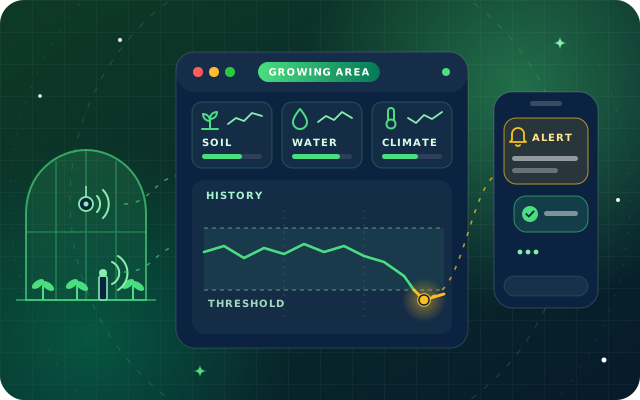
Every sensor now sits in the StarSense device registry with its greenhouse, growing area and type. Live telemetry for air temperature, humidity, soil moisture and irrigation flow and pressure appears on dashboards for each greenhouse and growing area, and floor-plan views of each greenhouse place every reading where the sensor sits. Gateways buffer readings locally when the farm's connection drops and upload them when it returns, so the record stays complete.
Thresholds and Alerts for Irrigation and Climate
Rules watch each growing area against the limits agreed for its crop:
- soil moisture moving outside the band for the crop and its growth stage
- a sudden change in line pressure, or irrigation flow outside its limits during an irrigation window
- temperature or humidity outside the agreed range, or changing faster than normal
- a sensor that stops reporting, or whose battery or signal is running low
Alerts carry a severity level, respect quiet hours for minor issues, merge duplicates and reach the growers responsible for that area on WhatsApp through StarBot, by email or as an in-app notification. If nobody acknowledges an alert, it escalates to a second contact. Anomaly scores compare each growing area with its own history and with its neighbors, so a slow drift, such as a fan losing performance, shows up before a hard limit is crossed.
History for Every Growing Area
Readings are kept in a time-series store with retention rules and downsampling, so growers can move from a whole-season view down to the raw readings for any day. Comparing the current crop cycle with the previous one in the same growing area is a matter of choosing the period, and scheduled reports in PDF and XLSX give the agronomist and management a regular summary without anyone compiling it by hand.
Automation, Introduced with Care
The existing irrigation and climate controllers stay in charge. StarSense rules that would open valves or adjust setpoints run in dry-run mode against live data, so the growers can see what the platform would have done before deciding how much control to hand over. When they choose to hand over control, the same platform provides remote control of valves and setpoints, safety interlocks and manual override with a record of who changed what.