The Challenge
The client makes plastic films, bags and rigid containers for food, retail and industrial customers. Production runs through extruders, injection molding machines and printing presses, supported by air compressors and process chillers that every line depends on, and the plant runs night shifts when order books are full.
Maintenance was mostly reactive. Technicians made their rounds with a clipboard, servicing followed the calendar rather than the condition of each machine, and the first sign of a worn gearbox bearing or a struggling hydraulic pump was often the machine itself stopping. Breakdowns were written in a logbook and copied into a shared spreadsheet when someone had time, so nobody could easily see which assets failed most or what each repair had cost.
The commercial damage came afterwards. Production was planned in StarBiz, but the plan only learned that a machine was down when a supervisor updated it, and by then a delivery date was often already lost. Rushed spare parts, overtime and difficult calls to customers followed, a pattern we see across Manufacturing.
- No live view of how critical machines were behaving
- Calendar-based servicing that missed wear on some assets and over-serviced others
- Breakdown history split between a logbook and a spreadsheet
- Downtime discovered by planners after deliveries had already slipped
Our Approach
We started with a site survey rather than a hardware list. With the maintenance and production managers we listed every asset whose failure stops a line, then ranked them by how often they had failed, how hard they were to repair and how much output depended on them. The extruder drives and gearboxes, the hydraulic units on the molding machines, the main air compressors and the process chillers came out on top.
For each of those assets we agreed what a technician would want to know before a failure: vibration and temperature on motors and gearboxes, current draw on drives and pumps, pressure on the compressed-air network, and supply and return temperatures on the chillers. The survey checked network coverage, which existing PLCs and controllers could be read over Modbus and where gateways could be mounted safely. Where an asset had no usable signal, the gap was closed with a new sensor rather than a custom integration.
The rollout ran in phases. A pilot on an extrusion line and the main compressor proved the sensors, the gateway positions and the quality of the data. Rules, alert routing and dashboards were then configured with the maintenance team, and the first rules ran in dry-run mode against live data, so the team could check what each one would have done before it was allowed to act. The remaining critical assets joined once the pilot readings were trusted.
Training was short and practical. Technicians learned to read an anomaly score, acknowledge an alert, confirm or dismiss it and close the linked work order in StarBiz. Planners learned how machine data from StarSense feeds production planning in StarBiz.
The Solution
Sensors, Gateways and Live Telemetry
Wireless vibration and temperature sensors were fitted to the motors and gearboxes of the critical machines, current sensors to the main drives and pumps, and readings from existing PLCs and compressor controllers were brought in over Modbus. Gateways on the factory floor send everything to StarSense and buffer readings locally if the link drops. Each asset sits in the device registry with its location, type and owner, and dashboards show every line with drill-down to the raw readings, along with device health such as battery level and last-seen status.
Learned Baselines and Anomaly Alerts
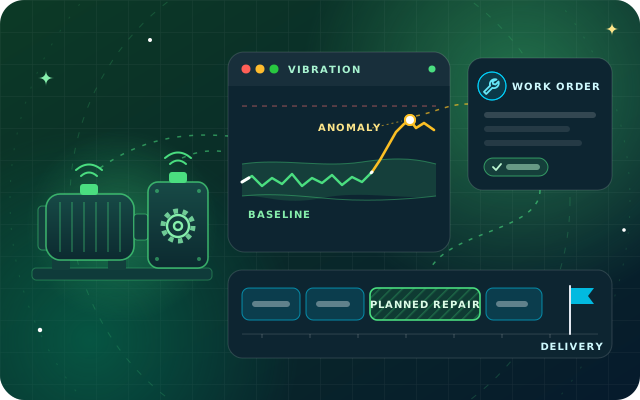
Instead of fixed limits that fire too often or too late, StarSense learned a baseline for each asset from its own history. Anomaly scores rise when vibration, temperature or current drift from that baseline, before a hard threshold is crossed, and the root-cause view correlates each event with readings from neighboring sensors. Run-hour and cycle counters drive usage-based servicing for the compressors and chillers. Alerts carry severity levels, are deduplicated, reach the responsible technician by email and in-app notification, and escalate to the maintenance manager when nobody acknowledges them.
Maintenance Work Orders in StarBiz
Anomalies above the agreed severity raise a maintenance work order in StarBiz automatically for the asset concerned, and the alert carries the readings that triggered it, so the technician walks in with the right part. Technicians confirm or dismiss every alert, and that feedback retrains the model for the asset. Each repair adds to the maintenance history and cost per asset, which now informs repair-or-replace decisions.
Downtime Visible in the Production Plan
StarSense also feeds machine data into StarBiz production planning, so planners and the maintenance team work from the same picture, and bottlenecks show up on the planning board before they hit a delivery date. When a machine is flagged, planners can fit the repair into a changeover or move orders to another line while there is still time. OEE and utilization dashboards show which machines lose the most time, and managers review them in their regular production meetings.