The Challenge
Every class at the school held a wide range of abilities. Teachers prepared one lesson for everyone, set the same homework and marked the same quizzes, so learners who were ahead grew bored while those who were behind fell further back. Teachers worked hard to differentiate, but doing it by hand meant extra worksheets in the evening and guesswork about who needed what. It is one of the challenges we meet most often in Education.
The bigger problem was timing. Gaps in understanding usually surfaced in end-of-term assessments, when it was too late to change the plan. Heads of department wanted earlier evidence of the skills a class had not grasped, leadership wanted progress reports drawn from real data rather than reconstructed at term end, and parents wanted to know how their child was doing between reports.
The school also had practical requirements. Classes worked in Arabic and English, some learners relied on keyboard navigation or larger text, and teachers wanted to keep the slides, worksheets and question banks they had already built rather than start again.
- One pace of teaching for very different learners
- Struggling learners identified at term end rather than as soon as they slipped
- Evenings lost to marking routine quizzes
- Progress reports for leadership and parents assembled by hand
Our Approach
We started with a discovery workshop with leadership and heads of department and agreed the goals the pilot would be judged on: earlier intervention, less time marking, higher engagement and reports drawn from live data. As in every StarLearn rollout, we did not promise a percentage. We agreed what would be reviewed, and how, at the end of the pilot.
Next came the skill map, the step that decides how well an adaptive platform works. With the subject teachers, we broke the pilot syllabus into skills and prerequisites, imported the school's existing material into the content library and tagged every item by skill. Question banks came in from spreadsheets, and teachers built the missing lessons with the block-based authoring tools, in Arabic and English where classes needed both.
Before the pilot began, we set up roles for learners, educators, administrators and guardians, applied the school's logo, colors and naming, and trained teachers on the dashboard and intervention tools. The pilot then ran with selected classes in a small number of subjects. Teachers met us regularly to share feedback, and we tuned the skill map, hints and question difficulty between sessions.
At the pilot review, leadership compared what had happened with the agreed goals and approved the wider rollout. The remaining classes joined in waves, each with its own training for teachers and, where relevant, an introduction for guardians. Review cycles each term keep the skill map and content up to date as the syllabus changes, and content versioning means an update does not break a path a learner is already following.
The Solution
Personalized Learning Paths
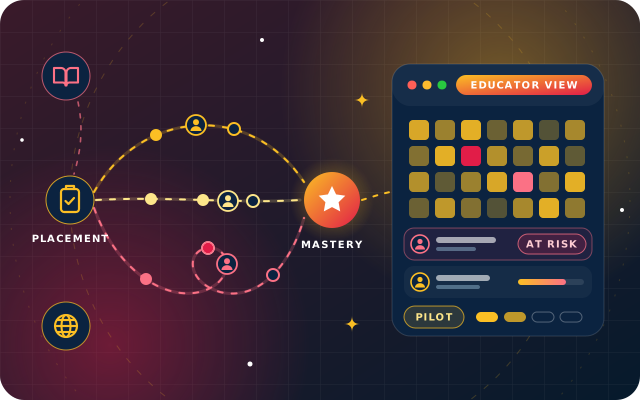
Every learner starts with a placement assessment that seeds a profile. StarLearn then recommends the next lesson, skill or revision block for that learner alone, adds remediation loops when a prerequisite skill is weak and offers stretch content to learners who are ahead. Teachers can pin, reorder or skip items, and learners see a path view that shows where they are and what comes next.
Adaptive Lessons and Assessments
Lessons and quizzes respond as answers arrive. Difficulty is tuned per question, hints and worked examples appear when a learner hesitates, and adaptive assessments shorten once mastery is clear. Every item carries a skill tag, so results are scored per skill rather than as a single grade, routine quizzes are marked automatically and spaced review brings back skills at risk of fading.
Educator Dashboards
Teachers open a cohort overview showing progress, activity and mastery at a glance, with at-risk flags for inactivity, low mastery or repeated errors. A skill heatmap for the class shows which skills are secure and which need teaching again, and a drill-down shows each learner's attempt history and time on task. Intervention notes and follow-up tasks are recorded in the same place. Skill-level reports feed lesson planning, and exportable reports go to leadership.
Guardian Views, Access and Languages
Guardians have their own role, with progress views and notifications for their own child only, and the school decides what learners can see, share and message. StarLearn runs in the cloud with the school's branding, and the interface works in Arabic and English with keyboard navigation, screen-reader support, a high-contrast mode and scalable text on desktop, tablet and mobile browsers.