The Challenge
This energy services company owns and maintains generators, transformers, switchgear and solar inverters at customer sites spread across the UAE. Each site supervisor kept a spreadsheet of the equipment in their care, and the fixed asset list in the accounts had drifted away from what was physically installed. Depreciation was worked out in a separate spreadsheet at year end, and moves between sites or disposals were recorded late, if at all.
Maintenance lived in paper logbooks kept on site. Supervisors relied on memory to know which services were due, so visits were sometimes missed and sometimes duplicated, and the history needed to support a warranty claim was scattered across notebooks. Customers who spotted a fault called whichever engineer they knew, which left requests depending on personal phones and nobody able to say where a job stood. These are the challenges we see most often in Energy and Utilities.
- Competing asset lists: operations and finance each kept their own, and neither was complete.
- Depreciation by spreadsheet: a year-end exercise instead of a scheduled posting.
- Paper maintenance logs: no shared view of what was due, done or overdue.
- Untracked fault reports: calls and messages to individual engineers, with no reference and no status.
Our Approach
Discovery started with workshops for operations, finance and customer service, followed by a walk-down of every site to verify and tag each asset against the old lists. We mapped the maintenance cycle from a scheduled service or a fault report through the visit, the parts used and the close-out, and the finance cycle from acquisition through depreciation to disposal. The fit-gap showed that StarBiz fixed assets, maintenance work orders and field service scheduling covered the core, with scheduled maintenance for each equipment category as the main configuration work, and that StarBot could take the routine customer conversations.
The work was phased so each team could settle before the next change:
- Asset register and depreciation: verified assets were imported with their cost, accumulated depreciation and site, and finance reconciled the opening balances before go-live.
- Scheduled maintenance: service plans were set up for each equipment category, and technicians were trained to update their jobs on mobile.
- Customer self-service: a StarBot knowledge base and guided flows were built in Arabic and English, piloted on the website and then extended to WhatsApp.
Each phase went through user acceptance testing with the people who would run it, and depreciation ran in parallel with the old spreadsheet until both agreed.
The Solution
One Fixed Asset Register, Tied to the Books
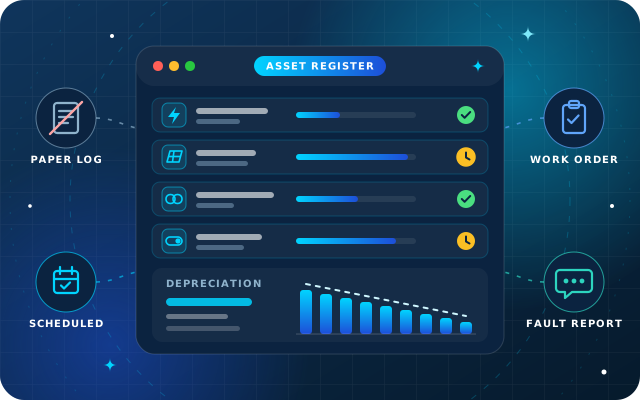
Every asset now has a single record in StarBiz with its site, equipment category, asset tag, supplier, purchase cost and warranty dates. Depreciation schedules post automatically in StarBiz finance, each site carries its own cost center and budget, and moves between sites or disposals are recorded against the asset itself. Finance and operations read the same register, so the asset base on the balance sheet matches what is on the ground.
Preventive Maintenance on a Schedule
Scheduled maintenance is set up for each equipment category, so StarBiz raises a work order whenever a service falls due, and planners use field service scheduling to assign each one to a technician by site. Technicians open the job on mobile, record the work done, the readings taken and the parts used, and close it on site. Spare parts are held in multi-location stock, with the main store and each service van set up as locations, and purchase requests for parts follow approval rules with a full trail. Every completed job adds to the asset's maintenance history.
Fault Reports and Status through StarBot
Customers now report faults on the website chat or on WhatsApp, in Arabic or English. A guided StarBot flow captures the site, the equipment and a description of the problem, and replies with a reference. The request goes to the service desk, and once a coordinator approves it, it becomes a maintenance work order in StarBiz, because StarBot changes ERP records only with approval. Customers can quote the reference at any time to ask StarBot where the job stands. StarBot also handles routine requests such as invoice copies, with every lookup scoped to the identity of the person asking. Words that signal an urgent fault, negative sentiment or a request for a person hand the chat to the service desk with the full transcript, and out-of-hours reports are captured with a promised call-back.
Dashboards for the Next Decision
Managers see overdue and upcoming maintenance by site, open fault requests and their status, and maintenance spending for each site against its budget. With an asset's maintenance history and its book value in the same system, a repair-or-replace decision starts from the asset's own record instead of a search through notebooks.