The Challenge
The client distributes personal care, beauty and baby care products to supermarkets, beauty retailers, convenience stores and wholesalers. It had outgrown its original warehouse and now ran several sites: a main distribution center, regional depots closer to customers and an overflow store rented for peak seasons.
Stock was recorded in an accounting package and a spreadsheet per warehouse, updated at the end of each shift. Sales staff phoned the warehouses to check availability before confirming an order, and the answer depended on who picked up the phone. Products sat in one depot while another ran short, and transfers between sites were arranged by phone and recorded later, if at all.
Inside the warehouses, pickers worked from printed lists and memory. Items from the same range in different sizes, scents or shades looked almost identical on the shelf and were often mixed up, cartons were counted by hand at the loading bay, and full stock takes closed the warehouses and still left differences nobody could explain. Without a physical count, finance could not trust the stock value. These are the typical Logistics and Supply Chain problems we are asked to solve:
- No single, current view of stock across warehouses
- Availability checked by phone before every order
- Transfers between sites arranged informally
- Picking errors between look-alike products and pack sizes
- Stock differences found only at full stock takes
Our Approach
We walked each warehouse with the operations manager and followed goods from the supplier's truck to the customer's delivery: receiving, checking, storing, picking, packing, loading and returns. We mapped how orders reached the floor, where paperwork was printed and where errors were caught or missed.
The fit-gap against StarBiz confirmed that its standard inventory and procurement module covered the core needs: multiple warehouses and locations, barcode operations, cycle counts, units of measure, lot and expiry tracking and reorder rules. The decisions that mattered were about structure: how to name and label locations, which products needed lot and expiry tracking, and which pack sizes each customer group bought.
We agreed a phased plan. The main distribution center went first, because most orders shipped from there, followed by the regional depots and finally the overflow store. Each phase started with racks and bays labeled to match the new location names, a cleaned product master with a barcode on every product, and opening quantities from a counted and reconciled stock take.
Testing used real orders from a busy period, replayed on a test system while the warehouse team scanned real products. Training happened at the racks rather than in a meeting room: receivers, pickers, packers and supervisors each practiced their own steps on handheld scanners until the new flow felt faster than paper.
The Solution
Warehouses and Locations in One System
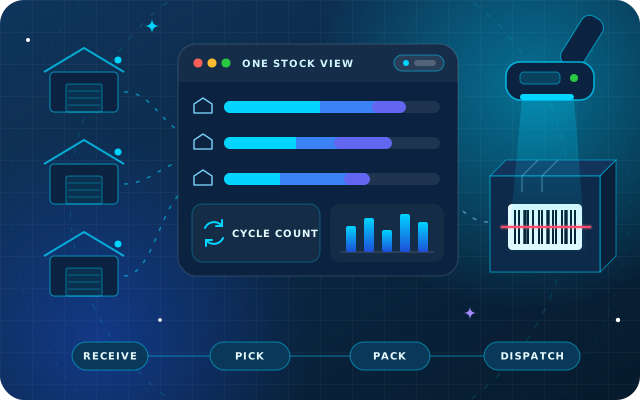
Every warehouse, and every zone and rack location inside it, is set up in StarBiz, so stock is recorded where it physically sits. Sales and purchasing see live quantities per warehouse and location, and transfers between sites are recorded in the system instead of being arranged by phone. Lots and expiry dates are tracked on the products that need them, with traceability reports ready if a supplier recalls a batch.
Barcode Receiving, Picking and Packing
Receivers scan goods against the purchase order as they arrive, and validated receipts update stock valuation automatically. Confirmed sales orders reserve stock at once and appear in the warehouse as deliveries ready to pick. Pickers and packers scan each product as they pick and pack it, so items are confirmed by barcode rather than by eye, which matters most for look-alike shades and pack sizes. Multiple units of measure with automatic conversion keep cartons, inner packs and single units consistent between purchasing, stock and sales.
Cycle Counts Instead of Shutdowns
Instead of closing warehouses for a full stock take, teams count a few locations at a time on scanners as part of the normal day. Stock adjustments outside normal patterns are flagged by StarBiz anomaly detection for review before they reach the month-end report. Reorder rules and min/max levels, with AI reorder suggestions, drive purchasing from real consumption rather than guesswork.
One Stock View for Sales and Dispatch
Sales staff check stock and margin in the quotation itself, so customers are promised goods that exist. Dispatch follows what is picked, packed and ready to load on live dashboards, and finance sees a stock valuation that moves with every receipt and delivery instead of waiting for a count. Role-based access decides who can see and change what, so depot teams work on their own operations while managers see every warehouse.