The Challenge
Purchasing at this organization ran on forms, email and signatures. A department completed a request form, attached supplier quotations and emailed it to its head, who forwarded it to finance to confirm the budget and then to procurement. Higher-value purchases went on to a committee, and the signed paper file became the official record. Each step depended on someone noticing an email, and a request could wait in an inbox with nobody aware of where it was.
Budget checks were made by hand against spreadsheets kept by finance, so a request could be approved against money already promised elsewhere. Purchase orders were typed separately, and when an invoice arrived, matching it to the order and the delivery meant pulling paper files from different offices. When internal audit asked why a supplier had been chosen, or who had approved a purchase and on what basis, the answer had to be assembled from emails, scanned signatures and memory.
Any new system also had to meet a firm requirement: the data had to stay inside the country, on infrastructure the organization controls, with backups it could prove would restore. These are constraints we meet in most Government and Public Services projects.
- Approval chains that lived in email, with no view of where a request was waiting
- Budget checks against spreadsheets, without sight of money already committed
- Supplier choices and approvals that were hard to evidence for audit
- Invoices matched to orders and deliveries by pulling paper files
- A firm requirement for on-premise hosting and verifiable backups
Our Approach
We started with the procurement policy rather than the software. Together with procurement, finance and internal audit, we turned the delegation of authority into an approval matrix: which roles approve which purchase categories, at which value bands, and when a second signature or a committee is required. Process mapping then traced a request from need to payment through each department, including the exceptions: urgent purchases, single-source justifications, budget transfers and requests sent back for more information.
The fit-gap review compared that map with StarBiz as standard. Purchase requisitions, RFQs, supplier comparison, purchase approvals, budgets and cost centers, three-way matching and the audit trail were all configuration, and the approval matrix became defined workflows with role-based permissions and record rules. Nothing in the policy needed custom development.
The infrastructure track ran alongside, with the organization's IT team. StarBiz was installed on the organization's own servers in its data center, with separate environments for test, training and production, TLS-encrypted connections and an encrypted backup schedule set by the IT team. A full restore drill from backup was completed in the test environment before go-live, so the backups had proved themselves before any live data depended on them.
Suppliers, cost centers, budgets and open purchase orders were then cleaned and migrated, and every path in the approval matrix was tested with real examples from recent files. Internal audit reviewed the audit trail output and signed it off before go-live. Training was role-based: requesters, approvers, procurement and finance each learned the screens they use, in the training environment and on their own data.
The Solution
Approval Chains Built from the Delegation of Authority
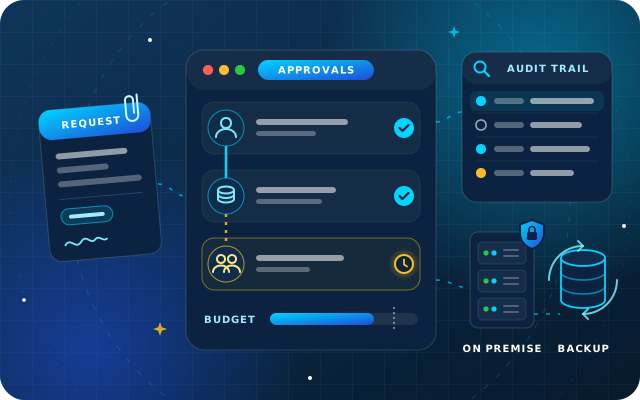
Every purchase starts as a requisition in StarBiz, raised by department staff against the cost center and budget line it will be charged to. The request then follows the approval workflow that matches its category and value: the department head, then finance to confirm the budget, then procurement, with two-step approvals and a committee stage for the highest value bands. Approvers see the request, the budget position and its history in one place, and approve, reject or send it back with a comment. Role-based permissions keep requesting, approving and paying in separate hands, and requesters can see at any moment where their request is waiting.
Budgets, Sourcing and Three-Way Matching
Budgets are held by cost center, so finance confirms each request against budget versus actual figures instead of a separate spreadsheet. Procurement issues RFQs from the approved request, records supplier quotations and compares them side by side, and the chosen supplier and the reason for the choice stay on the record. Purchase orders are created from the approved request without re-typing, and vendor performance is tracked across orders. When the vendor bill arrives, three-way matching compares the order, the receipt and the bill, mismatches stop for review instead of going to payment, and the StarBiz AI layer flags possible duplicate vendor bills for review.
An Audit Trail That Answers the Auditor's Questions
Every request, approval, rejection, comment and change to a purchase record is logged with the user and the time, so the trail shows who changed what and when. Internal audit has read-only access to the whole procurement history, and a question about why a supplier was chosen or who approved a purchase is answered from one record that holds the RFQ, the supplier comparison and the approval history. Fiscal-year locks and period closing controls protect closed periods, and reports export to PDF and XLSX for audit files.
On-Premise Deployment with Tested Backups
StarBiz runs entirely on the organization's own servers, so procurement and finance data stay inside the country on infrastructure it controls. The security model is the same as in the cloud: least-privilege access, encrypted transport and complete audit trails. Encrypted backups run on the schedule the IT team defined, restore drills are part of the operating routine, and data-retention policies follow the organization's record-keeping rules.