
AI and forecasting
AI in Odoo 19: What the New Features Can and Cannot Do
Ask AI, agents, AI fields and automation in Odoo 19: uses by department, limits, data and privacy questions, and where StarBiz and StarBot fit.
· 9 min read
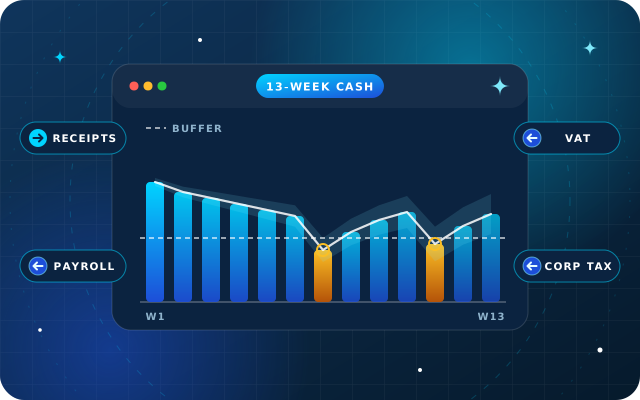
Your ERP already holds most of what a cash forecast needs. Here is how to turn open invoices, bills, orders, payroll and tax dates into rolling 13-week cash flow forecasting, with receipts based on how customers really pay and AI where it helps.
Key takeaways
Profit and cash part company all the time. A distributor can post its best month and still struggle to pay suppliers, because the customers who bought the most have not paid yet and a VAT payment lands in the same week as payroll. Cash flow forecasting closes that gap by showing, week by week, what will come in, what must go out and where the balance will land.
Most of the inputs already sit in your ERP: open invoices and bills, purchase and sales orders, payroll and tax history. This guide shows how to turn that data into a rolling 13-week forecast, how to forecast receipts from the way customers really pay, where AI helps, and how to run scenarios and keep the forecast owned.
A cash flow forecast answers one question: will we have enough cash, at the right time, for what we have committed to? It is not a budget, which plans income and costs for the year, nor the cash flow statement in your accounts, which explains what happened to cash in a past period.
Most businesses need two horizons. A short-term forecast, usually 13 weeks, manages liquidity: supplier payment runs, payroll, tax payments, loan repayments and use of a bank facility. A longer monthly forecast supports budgets, investment decisions and conversations with the bank.
The direct method lists expected receipts and payments by category, such as customer collections, supplier payments, salaries, taxes and rent. It is the natural choice for a 13-week view, because each line comes from a document or a schedule you can check. The indirect method starts from forecast profit and adjusts it for non-cash items, such as depreciation, and for changes in receivables, inventory and payables.
| Aspect | Direct method | Indirect method |
|---|---|---|
| Starting point | Opening bank balance | Forecast net profit |
| Built from | Expected receipts and payments | Profit adjusted for non-cash items and working capital |
| Best horizon | Days to about a quarter | Months to years |
| Main ERP data | Open invoices, bills, orders, payroll and tax schedules | Budget, balance sheet and working capital days |
| Typical use | Liquidity and payment planning | Annual planning and bank reporting |
Before you build anything, list each cash flow and where its data lives. For a typical UAE trading or services business:
Deadlines and rates can change, so check the latest guidance from the Federal Tax Authority for your own position; this guide is not tax advice.
The most common error in a cash forecast is assuming customers pay on the due date. Your ERP knows better: every paid invoice records when it was due and when the money arrived. From that history you can work out how late each customer usually pays, and how much that varies.
A worked example: a customer paid its last six invoices 12, 18, 15, 20, 16 and 21 days after the due date, an average of 17 days. It has three invoices open:
| Invoice | Amount (AED) | Due date | Expected receipt | Forecast week |
|---|---|---|---|---|
| INV-1041 | 85,000 | 10 August | 27 August | Week of 24 August |
| INV-1063 | 42,000 | 24 August | 10 September | Week of 7 September |
| INV-1077 | 120,000 | 7 September | 24 September | Week of 21 September |
A forecast built on due dates would show all AED 247,000 arriving about two and a half weeks earlier than this customer's history suggests, and a payment run planned against it would leave the account short. Refine the pattern over time: treat large invoices separately if they behave differently, hold disputed invoices out until they are resolved, and check whether your own history shows slower collections around the Eid holidays or the summer travel season.
A rolling forecast always looks 13 weeks ahead. Each week, actual figures replace the oldest week's forecast and a new week 13 is added. Step by step:
Take a business that starts its forecast on Monday 17 August 2026, with a 31 December year end and quarterly VAT periods ending in September. Two weeks stand out: week seven, which contains 30 September and the corporate tax for the 2025 financial year, and week eleven, which contains 28 October and the VAT for July to September. If month-end payroll and a large payment run fall in the same weeks, those are the weeks to plan first.
Tip: keep the forecast and the actuals in the same layout, line by line. When the variance is visible every week, the team quickly learns which lines need better data and which assumptions to change.
AI earns its place in the parts of the forecast that depend on patterns in history:
AI does not know about the contract signed yesterday, the customer who has just disputed an invoice or the shipment that will arrive early. New customers have no history, and one-off events do not repeat. A person still owns the forecast, and every manual adjustment should be logged with its reason, so you can see later whether it helped. The accuracy measures in our guide to AI demand forecasting for retailers and distributors, such as bias and comparison with a simple baseline, apply to cash forecasts too.
A single forecast hides risk. Keep a base case and add two or three scenarios that each change specific lines:
| Scenario | What changes in the model | Action it can trigger |
|---|---|---|
| The largest customer pays a month later | Its open invoices move back four weeks | Confirm the date with the customer early, or line up the facility |
| Sales slow for a month | Fewer new invoices, and later receipts from them | Slow purchasing and hold non-urgent spending |
| A container arrives two weeks early | The supplier payment, freight and duty move forward | Agree terms with the supplier or move the payment run |
| A large order is won | Purchases now, the receipt on its expected date | Check that the gap between paying and being paid is funded |
A forecast without an owner decays within weeks. Give it one owner in finance, usually the financial controller or treasurer, and agree who feeds which lines:
The forecast is only as good as the data behind it. Reconcile bank accounts every week, and our guide to bank reconciliation in Odoo shows how rules and bank feeds keep that quick. Record due dates and payment terms on every invoice and bill, post vendor bills when they arrive rather than at month-end, and keep expected dates on purchase orders up to date.
On Odoo Enterprise, the Accounting app's aged receivable and aged payable reports group open invoices and bills by how long they are overdue, and its cash flow statement shows how cash moved in past periods across operating, investing and financing activities. On Odoo Community, the free SBS Account Community module adds aged balances, partner ledgers, budgets and recurring payments.
In StarBiz, receivables, payables, purchasing, payroll and bank reconciliation share one data model, and the AI layer's time-series models, trained on your own history, project the cash position per week with confidence ranges rather than single figures. Managers can also ask questions of live data through StarBot, such as which customers are overdue by more than 60 days.
We build forecasting into the ERP rather than around it. Star Bit Solutions can:
Tell us how you forecast cash today through the contact page, or call +971 55 973 4524, and we will show you what your own ERP data can already tell you.

Star Bit Solutions is a software company in Ajman, UAE, founded in 2014. We implement and customize Odoo Enterprise and Odoo Community, and build StarBiz (AI-driven ERP), StarHub (life super app), StarBot (conversational AI), StarLearn (adaptive learning) and StarSense (AI and IoT platform). About us
Finance, sales, purchasing and payroll on one data model, with cash forecasting per week and confidence ranges.
Learn MoreOdoo Accounting with aged balances, bank reconciliation and financial statements, configured for UAE VAT.
Learn MoreFree module adding ledgers, aged balances, budgets and recurring payments to Odoo Community.
Learn MoreAsk AI, agents, AI fields and automation in Odoo 19: uses by department, limits, data and privacy questions, and where StarBiz and StarBot fit.
· 9 min read
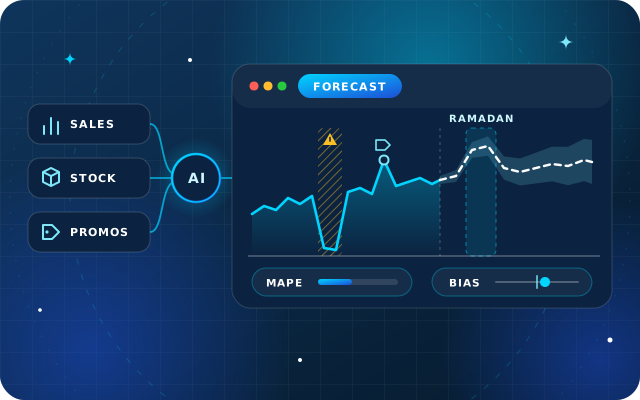
Clean sales history, stock-out flags, promotions, UAE seasonality, granularity, MAPE and bias, reordering rules, human overrides and a pilot plan.
· 10 min read
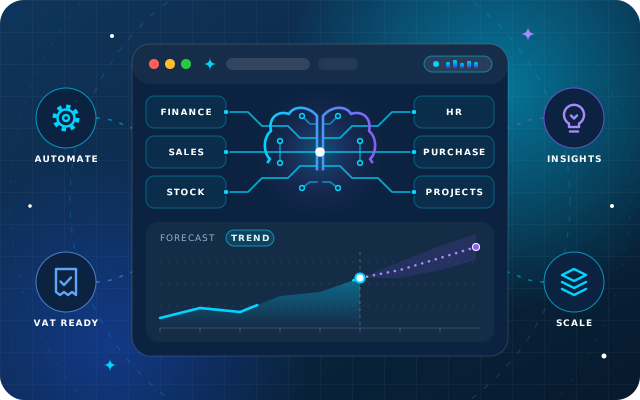
Forecasting, anomaly detection and automation explained with real workflows, plus the data you need in place first.
· 8 min read
It is a week-by-week projection of cash receipts, payments and closing balances for the next quarter, usually built with the direct method. Thirteen weeks is long enough to cover payroll cycles, supplier payment runs and a VAT period, and short enough to forecast from documents you already hold. It rolls forward every week, with actual figures replacing the forecast.
The direct method lists expected receipts and payments, such as customer collections, supplier payments, payroll and taxes, and suits short horizons. The indirect method starts from forecast profit and adjusts it for non-cash items like depreciation and for changes in receivables, inventory and payables. Many businesses use the direct method for 13 weeks and the indirect method for annual planning.
AI is most useful where history has patterns. A model trained on paid invoices can predict when each open invoice will actually be paid, and time-series models can forecast seasonal receipts such as daily takings. It cannot know about new contracts, disputes or one-off events, so a person should still review the forecast and log every adjustment with its reason.
Include VAT, which is payable by the 28th day after the end of each tax period, and corporate tax, which is payable within nine months of the end of the tax period, so by 30 September 2026 for a 31 December 2025 year end. Add any other taxes and fees you pay, and check the latest guidance from the Federal Tax Authority for your own deadlines.
There is no universal target. Measure the difference between forecast and actual closing cash every week, and track it line by line, so you can see whether receipts, payments or timing cause the misses. A forecast is doing its job when its errors are small compared with your cash buffer and do not lean consistently in one direction.
We set up a rolling cash forecast fed by StarBiz or Odoo, with receipts based on real payment behavior, scenarios and a weekly review.