ERP for Trading Companies in the UAE: A Buyer's Checklist
Star Bit Solutions9 min read
Multi-currency buying, landed costs, several warehouses, packaging units, customer prices, credit limits, VAT and e-invoicing: the requirements, vendor questions and demo script that help you choose an ERP for trading companies in the UAE.
Test the hard cases: multi-currency bills, landed costs, transfers between warehouses, packaging units, customer prices, credit limits and returns.
Give every shortlisted vendor the same demo script, built from a month of your own transactions, and ask them to run it live.
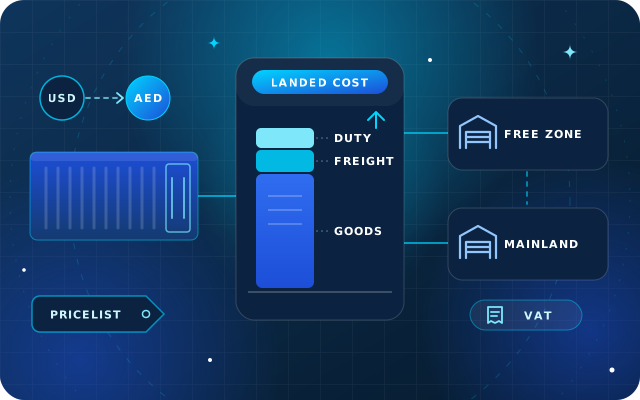
Landed costs change the margin picture: a line that shows 15.8% on purchase price can earn 6.3% once freight, duty and clearing are added.
Plan e-invoicing into the ERP project: larger businesses must appoint a provider by 31 July 2026 and go live on 1 January 2027.
A UAE trading company asks a lot of its ERP. It buys in dollars, euros or yuan and sells in dirhams, pays freight, duty and clearing on every container, holds stock in more than one warehouse, sells the same item by the piece, the carton and the pallet, and gives its best customers their own prices and credit terms. VAT touches almost every transaction, and mandatory e-invoicing arrives from 2027.
Most ERP demos show a clean sale from stock. This buyer's checklist helps you choose an ERP for trading companies in the UAE by testing the hard cases instead: the requirements to insist on, the questions to put to vendors, a demo script built from your own transactions and the implementation phases that follow.
What an ERP for Trading Companies in the UAE Must Handle
Trading margins are thin and built from many small numbers, so the system has to get each one right. Mark every requirement below as must-have, nice-to-have or not needed before you speak to any vendor.
Multi-Currency Buying and Selling
Purchase orders, bills and payments in the supplier's currency, with exchange rates updated automatically and exchange differences posted without manual journals. The dirham is pegged to the US dollar, so dollar purchases carry little currency risk, but euro, sterling, yuan or rupee purchases can move a margin between order and payment.
Landed Costs
Freight, insurance, customs duty and clearing charges added to the cost of the goods they relate to, split by quantity, value, weight or volume. Without landed costs, stock is undervalued and margin reports overstate profit on imported lines.
Warehouses, Locations and Transfers
Several warehouses, bin locations, goods in transit and transfers between sites, including between a free zone and the mainland. If you hold stock in a free zone, ask your tax adviser whether it is a designated zone for VAT, and your customs broker when duty falls due as goods move to the mainland, because both change how stock movements are recorded.
Units of Measure and Packaging
Buy by the container or pallet, stock by the piece and sell by the carton or the piece, with automatic conversion and, ideally, a price per packaging rather than a discount typed on every line.
Pricelists, Discounts and Credit Limits
Customer-specific prices, quantity breaks, promotions with start and end dates, prices in more than one currency, approval for discounts below a threshold, and a credit limit per customer with a warning or block when an order would exceed it.
UAE VAT and E-Invoicing Readiness
Correct tax codes for standard-rated, zero-rated, exempt and out-of-scope supplies, reverse charge where it applies, a VAT return that reconciles to the ledger and credit notes linked to their invoices. For e-invoicing, businesses with revenue of AED 50 million or more must appoint an accredited service provider by 31 July 2026 and go live by 1 January 2027, and smaller businesses follow by 1 July 2027. The ERP must hold every mandatory field the Ministry of Finance published in February 2026 and pass the data to the provider.
WhatsApp, Returns and the Customer Conversation
WhatsApp is a common channel for order confirmations, delivery updates and payment reminders in the UAE, so check whether the ERP sends approved message templates from an order or invoice; our guide to WhatsApp in Odoo shows what that looks like. For returns, look for returns tied to the original delivery, exchanges netted against a new sale and approval before stock and money move.
Questions to Ask Every ERP Vendor
Show us one container's freight and duty split across two products, and the margin report before and after.
How are exchange differences calculated and posted when a dollar bill is paid at a different rate?
Can one product be bought, stocked and sold in three different units, and where is each conversion stored?
What happens on screen when an order takes a customer over their credit limit: a warning, a block or an approval?
Which UAE VAT reports are standard, and how do they reconcile to the general ledger?
What is your plan for UAE e-invoicing: native support, a connector to accredited service providers or an integration project?
Which features need a higher edition, an extra license or custom development?
Can we meet the consultant who would run our project, and how many trial data loads are included before go-live?
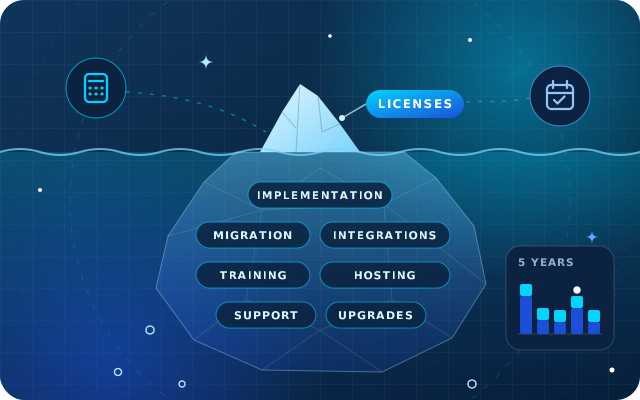
Compare the answers on cost as well as features: our guide to ERP total cost of ownership lists what to budget beyond licenses.
A Demo Script Built from Your Own Transactions
Give every shortlisted vendor the same script, built from a recent month of your own trading, and ask them to run it live. Here is an example for a distributor importing two products in one container:
Purchase: raise a purchase order in US dollars for 600 cartons of product A and 400 cartons of product B, worth AED 48,000 and AED 62,000 at the order-date rate.
Receive and transfer: receive the container into your main warehouse, then transfer 200 cartons of A to a second warehouse.
Add landed costs: freight of AED 6,000 split by volume, with B taking 60% of the space, customs duty of AED 5,500 split by value and clearing of AED 1,000 split by quantity.
Check the cost: A should now cost AED 89.00 a carton and B AED 172.75, instead of AED 80 and AED 155.
Sell: quote 150 cartons of A at the customer's pricelist price of AED 95, partly in cartons and partly in pieces, to a customer this order takes over their credit limit.
Deliver and invoice: deliver 100 cartons, invoice them with 5% VAT and show the e-invoice data the system would send.
Return: take back 5 cartons and show the receipt, the credit note linked to the invoice and the VAT reversal.
Pay and report: pay the dollar bill at a new rate, then show the exchange difference, margin by product and customer, stock value by warehouse, aged receivables and the VAT return.
Here is the landed cost step worked through, so you can check the vendor's answer:
Cost line
Split by
Product A (AED)
Product B (AED)
Goods
Purchase price
48,000
62,000
Freight of 6,000
Volume, 40:60
2,400
3,600
Customs duty of 5,500
Value
2,400
3,100
Clearing of 1,000
Quantity, 600:400
600
400
Landed cost
53,400
69,100
Per carton
89.00
172.75
At a selling price of AED 95, product A shows a 15.8% gross margin when costed at its purchase price, but only 6.3% at its landed cost. A system that cannot show the second figure lets a sales team discount the profit away.
Have a question about this guide? Ask the engineers who wrote it.
Odoo Enterprise, Odoo Community and StarBiz for Trading
We implement all three, so here is where each fits for a trading business. Odoo Enterprise covers most of the checklist with standard apps: Accounting for multi-currency and the UAE VAT return, Inventory for warehouses, routes and landed costs, Sales for pricelists, Barcode for scanning and the WhatsApp app for approved templates. In Odoo 19, landed costs can be split equally, by quantity, by current cost, by weight or by volume, for products valued at average cost or FIFO, and the Sales Credit Limit setting raises alerts on orders and invoices for customers over their limit.
Requirement
Odoo Enterprise
Odoo Community
StarBiz
Multi-currency
Standard
Standard
Standard
Landed costs
Standard
Standard
Standard
Units and packs
Unit conversion, with quantity breaks in pricelists
Unit conversion, plus a price per pack with the free SBS Multi UoM module
Multiple units with automatic conversion
Barcode operations
Barcode app
Not included
Standard
UAE VAT return
UAE VAT report
Sales and purchase tax report with SBS Account Community
Configurable VAT reporting
WhatsApp messages
WhatsApp app
Through StarBot
Through StarBot
Returns with approval
Standard returns and credit notes
Free SBS Auto Return module
Controlled approval
Hosting
Odoo Online, Odoo.sh or on-premise
On-premise or private cloud
Cloud, on-premise or hybrid
Odoo Community shares the core Sales, Purchase and Inventory apps without a license fee, but has no full Accounting app, Barcode or WhatsApp. Our free modules, built and tested on Community, close some trading gaps on a self-hosted database: SBS Multi UoM sets a price per packaging and freezes the ratio and price on every document, and SBS Auto Return puts returns and exchanges on a two-step approval. Our guide to returns with discounts and multiple units of measure shows both in a real flow.
StarBiz, our AI-driven ERP, has multi-warehouse stock, multiple units of measure with automatic conversion, landed costs and three-way matching, price lists with discount approval rules, returns with controlled approval and multi-currency ledgers, plus AI reorder suggestions and WhatsApp follow-ups through StarBot.
Whichever system you choose, ask early how invoice data will reach your accredited service provider for UAE e-invoicing, because that connection needs its own design and testing.
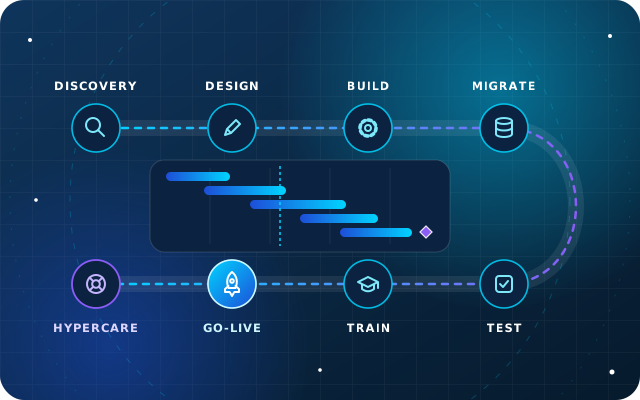
Implementation Phases for a Trading Company
Discovery: map how you buy, store, sell and collect, and list the reports management really uses.
Design: agree the chart of accounts, warehouses, units of measure, pricelists, credit rules, tax codes and approval limits, and prototype them on your sample data.
Configuration: build in short iterations, demonstrate each area to the people who will use it, and customize only where the design proves it necessary.
Data migration: load customers, suppliers and products, then open orders, stock by location at landed cost, open receivables and payables and opening balances, with at least one trial load reconciled to your current system; our article on opening balances and cut-over covers this step.
Testing: rerun the demo script on the configured system, plus month-end, VAT return and returns scenarios.
Go-live and hypercare: cut over at the start of a month or VAT period, count stock on the day and keep engineers on hand while teams settle in.
Plan e-invoicing into the same project rather than after it, because for larger businesses the provider deadline may fall mid-implementation. Our article on what the 2025 e-invoicing decisions mean for your ERP explains the scope and the data required.
How Star Bit Solutions Can Help
Star Bit Solutions has built business software in the UAE since 2014, and our Trading and Commerce page shows which of our products and modules fit traders and distributors. We can:
turn your requirements into a checklist and a demo script built from your own transactions;
implement the system, migrate your data and plan e-invoicing into the same project.
Send us a month of typical transactions through the contact page, or call +971 55 973 4524, and we will build the demo around them.
Written by the Star Bit Solutions team
Star Bit Solutions is a software company in Ajman, UAE, founded in 2014. We implement and customize Odoo Enterprise and Odoo Community, and build StarBiz (AI-driven ERP), StarHub (life super app), StarBot (conversational AI), StarLearn (adaptive learning) and StarSense (AI and IoT platform). About us
Discovery, fit-gap design, configuration, migration, testing, training, go-live and hypercare explained, with the roles on both sides and the risks to watch.
What is the best ERP for a trading company in the UAE?
There is no single best system: the right ERP is the one that runs your own transactions cleanly. For a UAE trader, test multi-currency purchasing, landed costs, several warehouses, units of measure, customer pricelists, credit limits, VAT and e-invoicing readiness with a script built from your own data. Running that script on each shortlisted system shows you the gaps before you sign.
Why do landed costs matter for traders?
Landed costs add freight, insurance, customs duty and clearing charges to the cost of the goods they relate to. Without them, stock is undervalued and margin reports overstate profit on imported products, which can lead to discounts that remove the real margin. An ERP should split each charge by quantity, value, weight or volume and update the stock valuation when the charge is posted.
Does a UAE trading company need e-invoicing in its ERP?
Yes, if it sells to other businesses or to the government. Under Ministerial Decision No. 244 of 2025, businesses with revenue of AED 50 million or more must appoint an accredited service provider by 31 July 2026 and go live by 1 January 2027, and smaller businesses by 31 March 2027 and 1 July 2027. The ERP must hold the mandatory invoice data and pass it to the provider.
How long does an ERP implementation take for a trading company?
It depends on the number of companies, warehouses and products, the quality of your data and the integrations you need. A single company with one or two warehouses is a much smaller project than a group with free zone and mainland entities. Ask each vendor for a phased plan covering discovery, design, configuration, data migration, testing and go-live, with dates you can hold them to.
Can Odoo handle multiple units of measure for trading?
Yes. Once Units of Measure and Packagings are enabled, Odoo converts between units automatically, so you can buy by the pallet, stock by the piece and sell by the carton. On Odoo Community, the free SBS Multi UoM module adds a price per packaging and freezes the ratio and price on each document line, so later price changes never alter documents already issued.
StarBiz by Star Bit Solutions
Choose Your ERP on Your Own Transactions, Not a Sales Deck.
Send us a month of typical purchases and sales, and we will run them through Odoo Enterprise or StarBiz, with landed costs, pricelists and VAT.